|
COPYRIGHT NOTICE
All material on this website, not otherwise in the Public Domain, including all original photos, essays, articles, descriptions and commentary published herein, are © Copyright 2010 by the Hamden Fire Retirees' Assn., and may not be copied, republished or transmitted in any form whatsoever without prior written permission of the Hamden Fire Retirees' Assn.
|
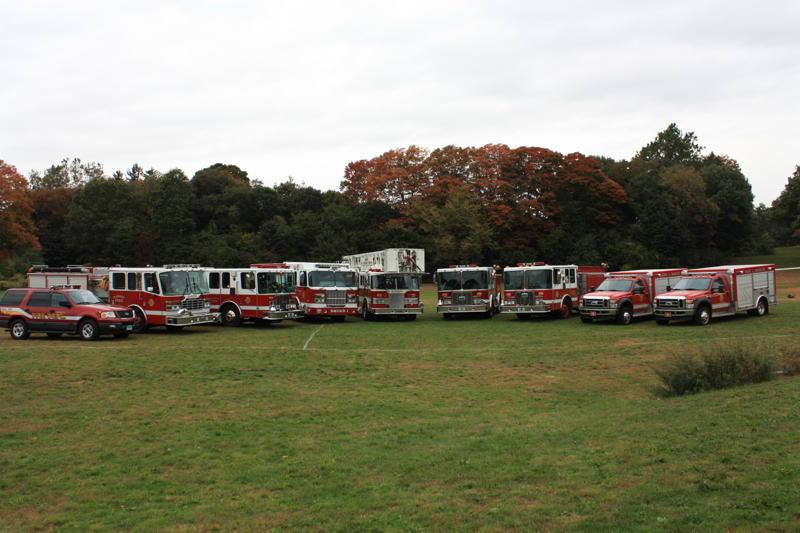 |
| 2009 - Assembly of all active career line apparatus - B/C Car, 5 Engines, 1 Truck, 2 Rescues - Photo by Capt. Ron Desroches |
|
|
__________________________________________________________________________________________________________
|
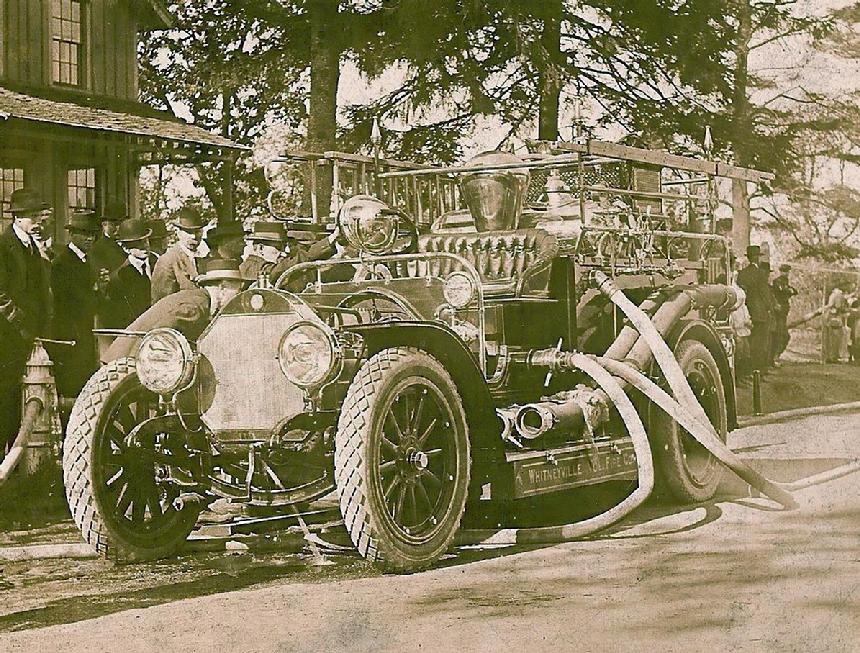
Hamden First Motorized Pumping Engine
1915 Maxim on a Thomas Flyer Chassis
Delivered to Whitneyville in June 1915
|
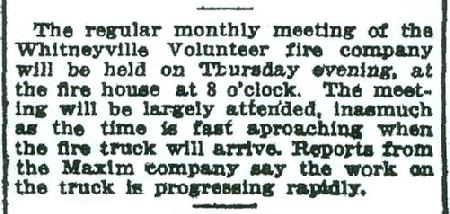 |
| January 1915 article from The New Haven Evening Register (Courtesy of Clark Hurlburt) |
|
In 1915, the Whitneyville Fire Association purchased this brand new Maxim triple combination pumping engine for $5,500. The apparatus was built on a Thomas Flyer chassis. Even though Mt. Carmel had acquired a Model-T Ford roadster in 1913 to pull its hose cart, the 1915 Maxim was Hamden's first bona fide motorized fire apparatus. It was considered a "triple combination" pumper, having a 500 GPM rotary gear pump, a supply of hose, and chemical tanks, as can be seen behind the driver's seat.
This 1915 Maxim also had the distinction of being the Maxim Company's first motorized pumping engine, as noted by author Walter McCall in his 1976 book, American Fire Engines Since 1900, (1976: Crestline Publications, Inc., Glen Ellyn, IL).
|
__________________________________________________________________________________________________________
|
1910 Locomobile Chemical Truck
Donated to Whitneyville in 1915
|
 |
| 1910 Locomobile Chemical Truck (Courtesy of Walter McCall) |
|
Whitneyville also acquired a chemical truck from the Winchester Repeating Arms Co. in 1915. It was built on a 1910 Locomobile chassis. Winchester's "powder farm" represented a large portion of the area along Putnam Avenue in those days, and Winchester donated the Locomobile chemical truck for use on smaller grass and brush fires so that Whitneyville's new Maxim pumper would be reserved "for graver emergencies."
Until recently, it was thought that Whitneyville's 1915 Maxim was turned over to Dunbar Hill Co. 8 in 1928 when Hamden bought a new Maxim 750 GPM pumper for Whitneyville Co. 3. But it was Whitneyville's 1910 Locomobile that went to Dunbar Hill. The fate of Whitneyville's 1915 Maxim is as yet unknown.
|
__________________________________________________________________________________________________________
|
1924 Stutz 350
Delivered to Whitneyville Annex (Merritt Street) in April 1924
|
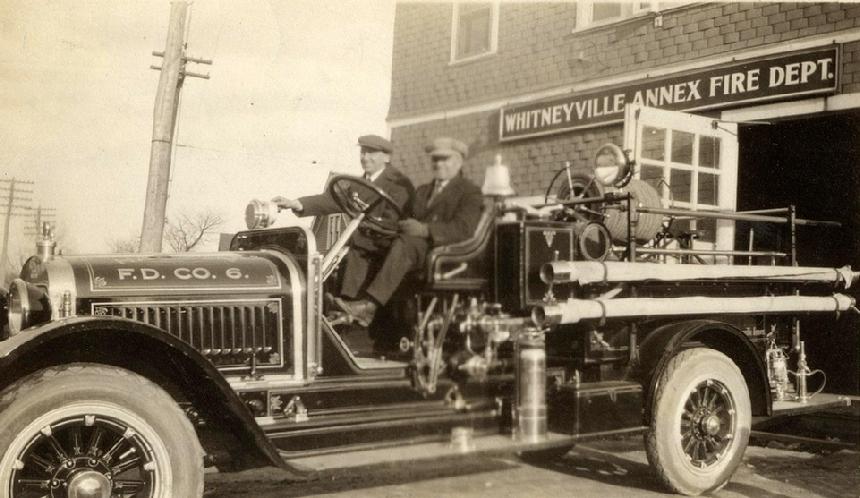 |
| April 1924 - Co. 6 member August Schoepfer is behind the wheel of this shiny new 1924 Stutz 350 GPM Pumper |
|
|
__________________________________________________________________________________________________________
|
1926 Maxim 500
Delivered to Highwood in March 1926
|
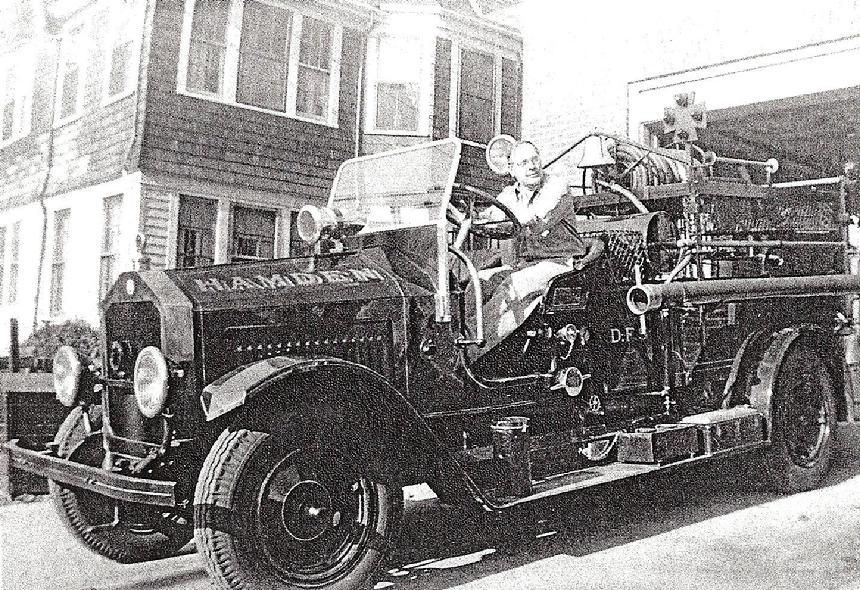 |
| Sid Trower at Station 3 at the wheel of the 1926 Maxim 500 GPM rotary gear pumper (Photo courtesy of Joe McDermott) |
|
|
__________________________________________________________________________________________________________
|
1928 Maxim 750
Delivered to Whitneyville in February 1928
|
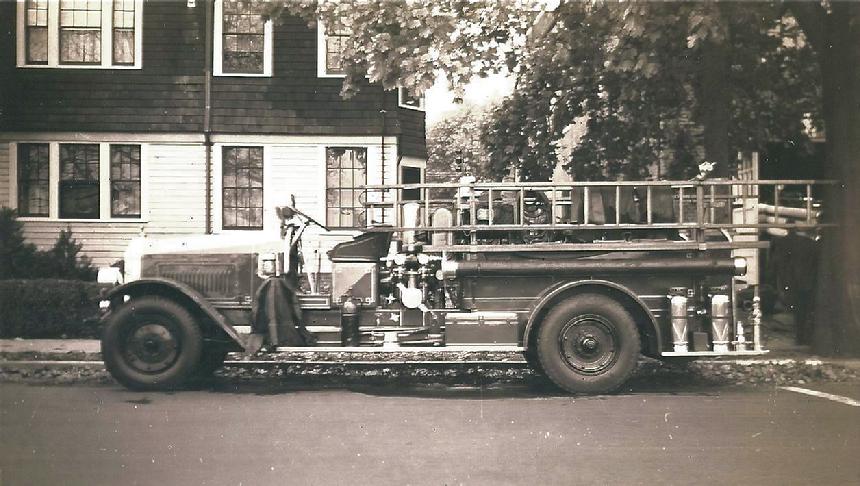 |
| 1939 - The 1928 Maxim 750 on Putnam Avenue next to Station 3 (Photo by G. Donald Steele) |
|
|
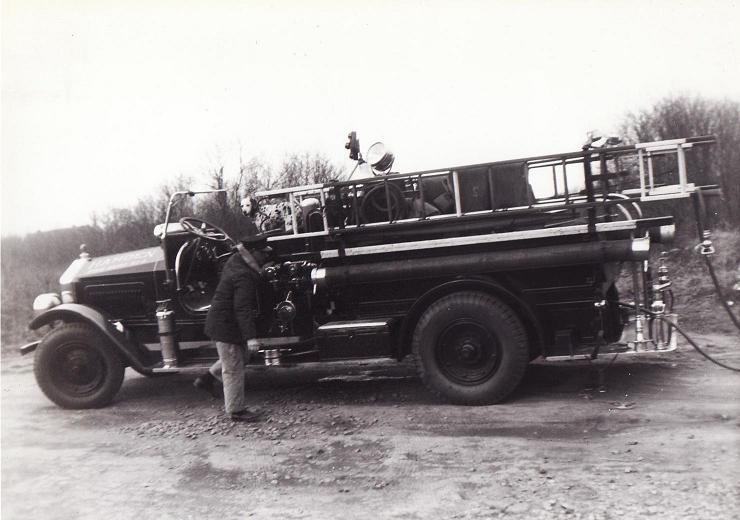 |
| Winter 1951 - Engine 3 (1928 Maxim 750 GPM) at rubbish pile fire behind housing development on Fennbrook Dr. Driver is Ralph Rosson, along with mascot "Belle." (Photo by Chandler Brainard) |
|
|
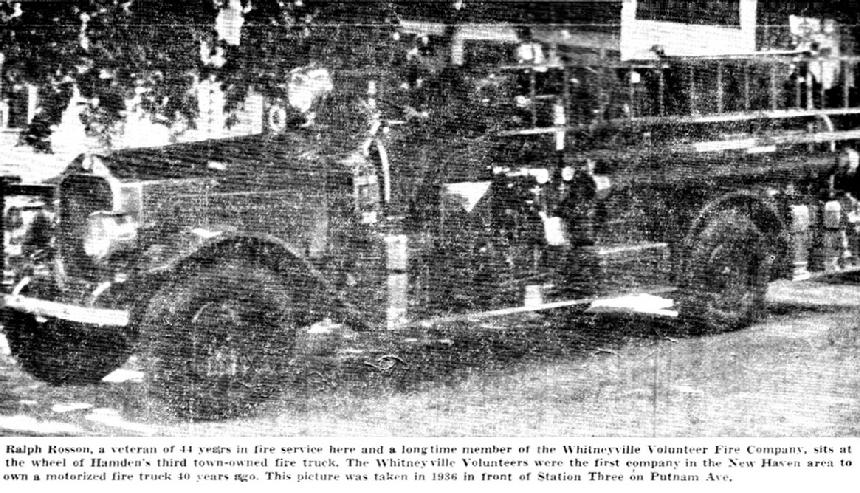 |
| February 19, 1953 Chronicle article courtesy of Gil Spencer - CLICK to enlarge for easier reading. |
|
|
__________________________________________________________________________________________________________
|
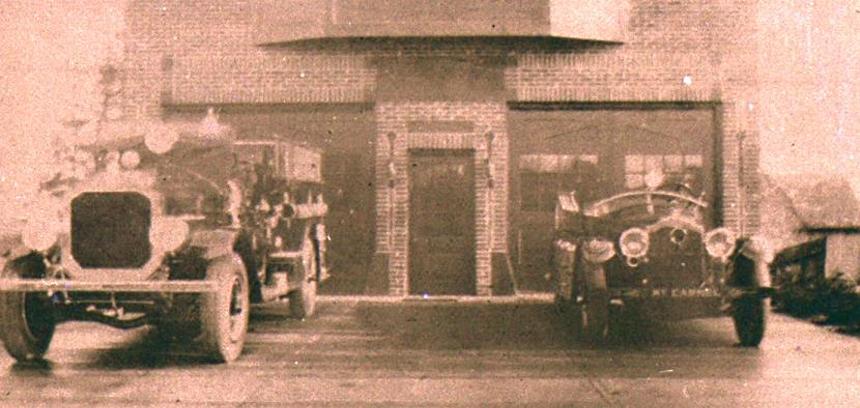
1930 Maxim 600
Delivered to Mount Carmel in January 1930
|
Pictured on the front ramp at Station 5 in Mt. Carmel are a 1930 Maxim 600 GPM rotary gear pumper and a 1921 Packard Twin-6 "Fire Patrol" wagon.
Organized in November 1911, the Mt. Carmel Volunteer Fire Co. built their fire station in 1925 and it opened in January of 1926. Starting with only one paid driver, career personnel have been stationed continuously at the Mt. Carmel station ever since.
The first paid driver in Mt. Carmel was Al Purce. Purce was one of the first two paid captains in 1942. He was assigned fire marshal duties in 1944, and became the Department's full time Marshal in 1949. Before the Hamden Fire Department was created in 1925, the duties of fire marshal fell to the First Selectman.
|
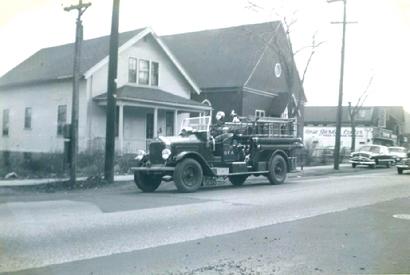 |
| CLICK to enlarge - This photo of Engine 6 was taken by Chan Brainard on State Street sometime between 1952 and late 1954. It is parked on the east side, almost opposite Ridge Road. The white building is 1959 State, a private residence. The darker building, 1953 State, was St. Stephen's Church, long before the new church was built on Ridge Road. |
|
|
 |
| CLICK to enlarge - This photo was taken at the same time but from a different POV. Notice the same white markings on the larger utility pole in both pix. The Hamden branch of the Connecticut Dept. of Motor Vehicles stands there today. Engine 6 was the 1930 Maxim 600 GPM pumper from August 1952, when it was transferred from Station 5, until October 1954, when it was replaced by the 1939 Diamond-T that had been Engine 4 since new. |
|
|
__________________________________________________________________________________________________________
|
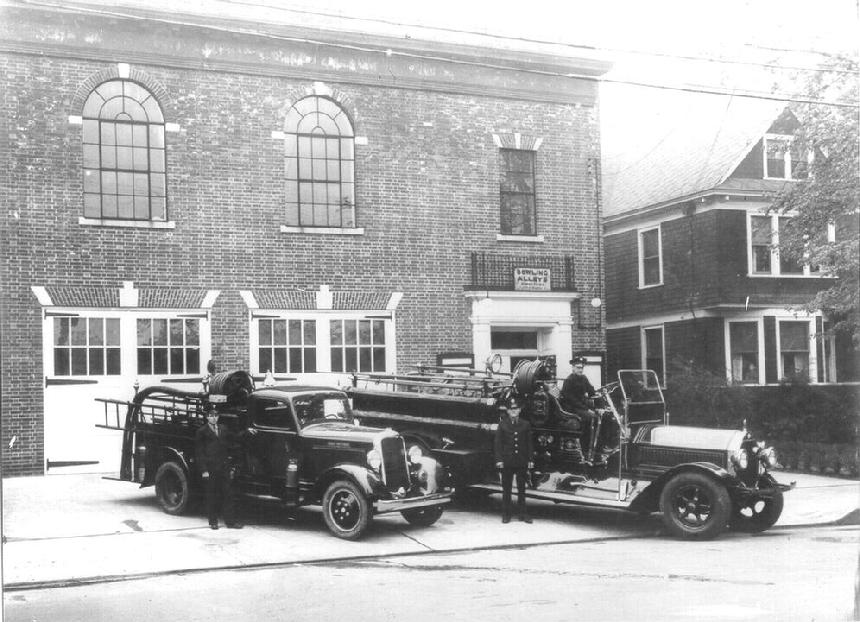 |
| MAY 1939 - 1935 Dodge 150 GPM and 1919 Seagrave 750 GPM pumper (Copy of original photo courtesy of Chan Brainard) |
|
|
Engine 7 (Mix District) - 1935 Dodge Bros. 150 GPM, purchased August 12, 1935 for $750. Utilized body of 1918 Stewart. Total cost: $1,267. Tank capacity 100 gal.
Engine 2 (Humphrey) - 1919 Seagrave 750 GPM, purchased June 1919 for $12.500. Transferred to Co. 1 on May 13, 1939 while Engine 1 was being repaired. (Job finished 1/25/1940) Balloon tires replaced the original solid rubber tires in 1925. Sent to Station 5 as a spare in 1942.
NOTE: Hamden's only right-hand drive apparatus were Whitneyville's 1910 Locomobile chemical truck, their 1915 Thomas-Flyer Maxim combination pumper/chemical engine, and Humphrey's 1919 Seagrave 750 pumper. By 1916, virtually all American-made motor vehicles were left-hand drive.
A few American fire apparatus manufacturers, most notably American LaFrance, Arhens-Fox, and Seagrave, continued to build right-hand drive apparatus into the early 1930s, perhaps because it was easier for the drivers to spot hydrants. The smaller left-hand drive 1925 Seagrave Suburbanite was an exception because it was built on a smaller chassis than Seagrave's full-size apparatus. (Also check out Co. 9's 1929 Seagrave tiller ladder truck on the Ladder Trucks page.)
From personal notes of Chief Charles Loller (courtesy of his great grandson, Russell Loller)
|
__________________________________________________________________________________________________________
|
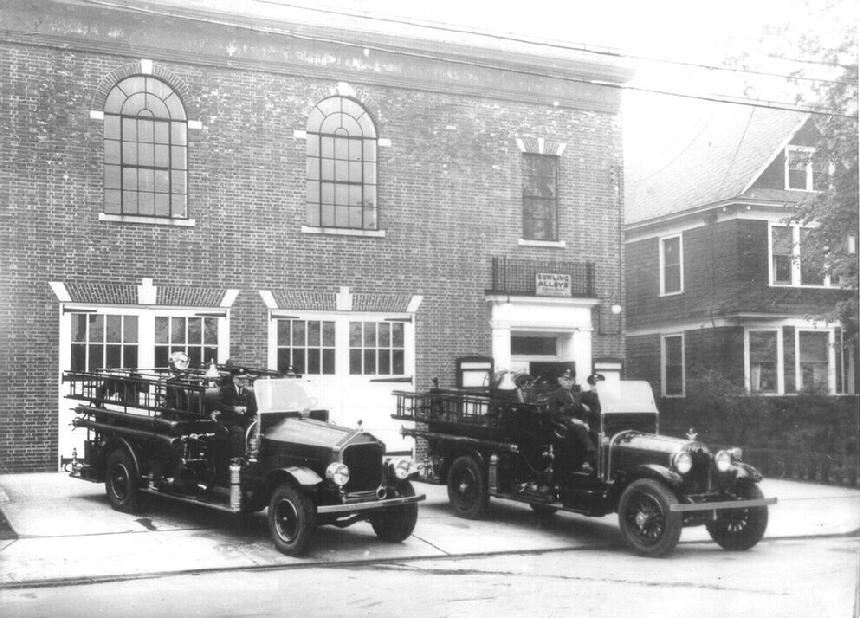 |
| MAY 1939 - 1930 Maxim 600 GPM and 1924 Stutz 350 GPM (Copy of original photo courtesy of Chan Brainard) |
|
|
Engine 5 (Mt. Carmel) - 1930 Maxim 600 GPM rotary gear pumper, delivered January 6, 1930, cost $8,500. It was transferred from Station 5 to Station 6 on August 6, 1952. It remained the department's spare engine from 1954 until 1960, when it was traded-in for $300 worth of credit at O.B. Maxwell's (ouch!).
Engine 6 (Merritt Street) - 1924 Stutz 350 GPM, purchased April 1924 for $7,150. Tank capacity 70 gals. Weight: 11,000 lbs. Became a spare in April 1942. A Dunbar Hill Co. 8 photo proves that the 1924 Stutz was still around as of 1947. A May 18, 1950 Hamden Chronicle article cites Co. 7 member Dwight Kirk as being the "private owner" of a 1925 Stutz pumper, which is probably the same piece of apparatus.
From personal notes of Chief Charles Loller (courtesy of his great grandson, Russell Loller)
|
__________________________________________________________________________________________________________
|
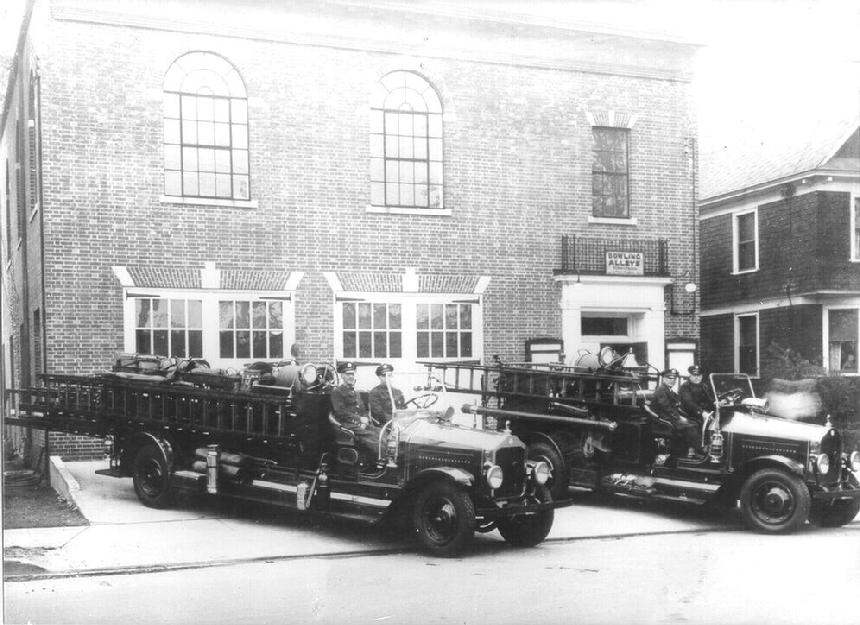 |
| MAY 1939 - 1926 Maxim City Service Ladder and 1926 Maxim 500 GPM pumper (Copy of original photo courtesy of Chan Brainard) |
|
|
Hook & Ladder Co. 1 (Highwood) - 1926 Maxim City Service Ladder Truck. Weight: 10,100 lbs. Purchased March 23, 1926. Windshield installed 2/15/38. On March 19, 1941 at 4:31 p.m., this ladder truck was struck by a trolley car at the corner of Dixwell Avenue and Mather Street and was subsequently traded into the Wood Engineering Service of Topsfield, Massachusetts for a new city service ladder truck on a Diamond-T chassis.
Engine 1 (Highwood) - 1926 Maxim 500 GPM rotary gear pumper. Purchased March 23, 1926. Traded in to the O.B. Maxwell Co. on January 18, 1954 for $900.00 toward purchase of a 1954 Maxim pumper.
Purchase price for both apparatus was $12,500.
From personal notes of Chief Charles Loller (courtesy of his great grandson, Russell Loller)
|
__________________________________________________________________________________________________________
|
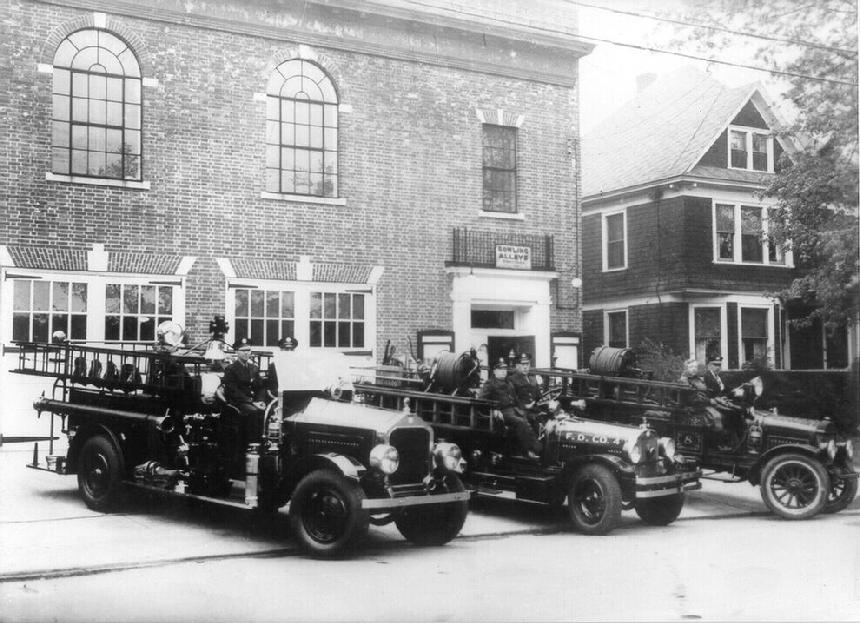 |
| MAY 1939 - 1928 Maxim 750 GPM, 1925 Seagrave Suburbanite 350 GPM, and 1918 Stewart Chemical (Copy of original photo courtesy of Chan Brainard) |
|
|
Engine 3 (Whitneyville) - 1928 Maxim 750 GPM rotary gear pumper, purchased February 1928 for $12,500. 70 gal. tank. Weight: 14,000 lbs. Traded in to the O.B. Maxwell in July 1952 for $500 toward purchase on new 1952 Maxim 750 GPM pumper.
Spare - 1925 Seagrave Suburbanite 350 GPM, purchased May 7, 1925 for $6.500. Original tank capacity was 40 gal. Weight: 10,000 lbs. (Removed from service as Engine 4 in April 1938, it was transferred to Co. 8 on September 18, 1939 after being fitted with 150 GPM pump and a 200 gal. tank.) Traded in to the O.B. Maxwell Co. in 1959 for $250.00 toward purchase of the 1959 Maxim "cab-forward" pumper.
Engine 8 (Dunbar Hill) - 1918 Stewart - Originally purchased by Mt. Carmel Vol. Co. on December 24, 1918 for $1,900. Tranferred to Co. 8 on August 18, 1930. Sold September 1939.
From personal notes of Chief Charles Loller (courtesy of his great grandson, Russell Loller)
|
__________________________________________________________________________________________________________
|
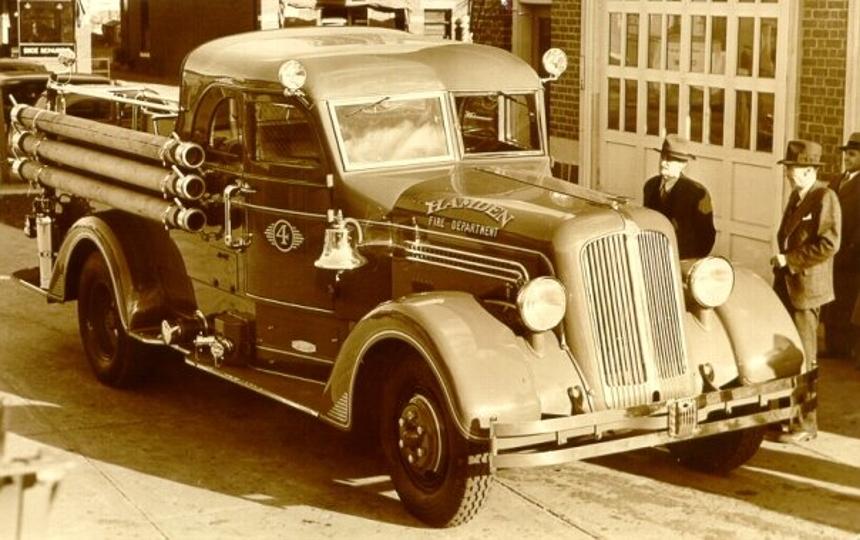
1938 Seagrave 600 "Canopy Cab"
Delivered to Centerville April 1938
(Transferred to Humphrey in June 1939)
|
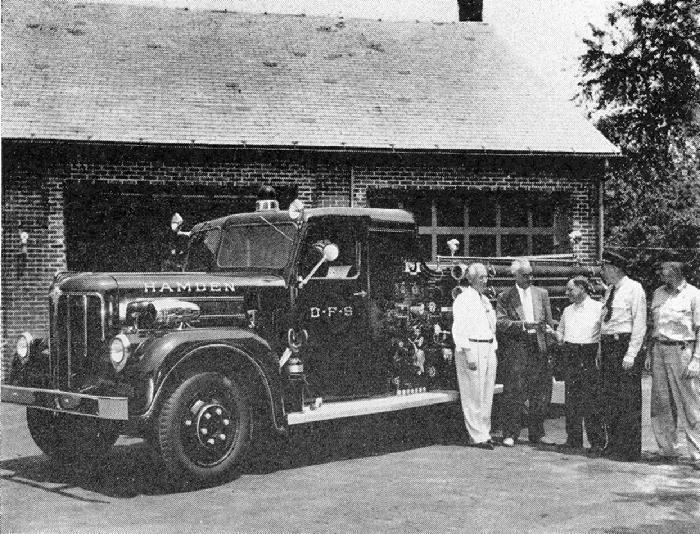
This is the April 1938 delivery photo of Hamden's new 1938 Seagrave Canopy Cab 600 GPM pumper in front of the north-facing bay doors of the Town Hall fire station (Station 4) before the bay doors were relocated to face Whitney Avenue.
This pumper was a "floor model" that was already painted the bright "Seagrave Red" when it was purchased by Hamden. Within a few months this pumper was repainted the darker "Maxim Red," as can be seen in the 1939 photo immediately below. Note that the words "FIRE DEPARTMENT" were omitted from the hood when it was repainted.
The three gentlemen at the right are identified as Chief Charles Loller, Commissioner James Gillies and Commissioner Albert Ruwet. On May 21, 1938, a few weeks after this photo was taken, Cmmr. Gillies died suddenly. In the late 1950s, the Board of Fire Commissioners presented his widow with the dedication plaque of the '38 Seagrave.
|
__________________________________________________________________________________________________________
|
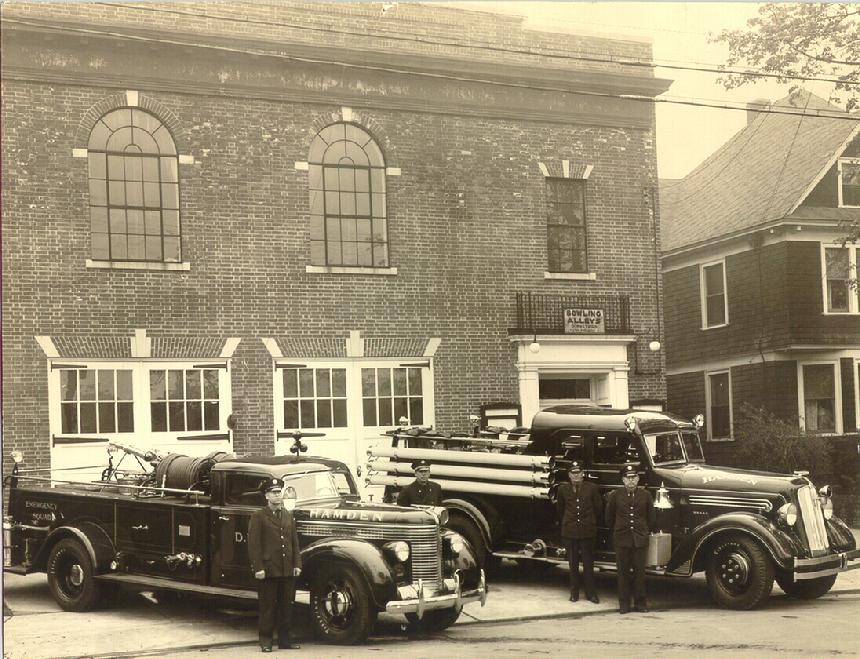 |
| MAY 1939 - 1938 Diamond-T Squad e/w 150 GPM pump and 1938 Seagrave Canopy Cab 600 GPM pumper. L-R: Roland Ruwet, 1st Asst. Chief Raymond C. Spencer, Joseph Dukat, and Robert Reutenauer |
|
|
Emergency Squad - 1938 Diamond-T e/w 150 GPM pump and deluge set. Placed in service at Station 4 at 6 p.m. on February 26, 1938. Cost $1,976. Weight: 10,500 lbs. Sold at auction in November 1971 for $272.00.
Engine 4 - 1938 Seagrave Canopy Cab 600 GPM pumper. 100 gal. tank. Placed in service at Station 4 as Engine 4 on April 12, 1938. Cost: $7.524. Transferred to Co. 2 on June 13, 1939, where it remained labeled with a big "4" on the doors until it was sold three decades later. Weight: 13,000 lbs.
From personal notes of Chief Charles Loller (courtesy of his great grandson, Russell Loller)
|
__________________________________________________________________________________________________________
|
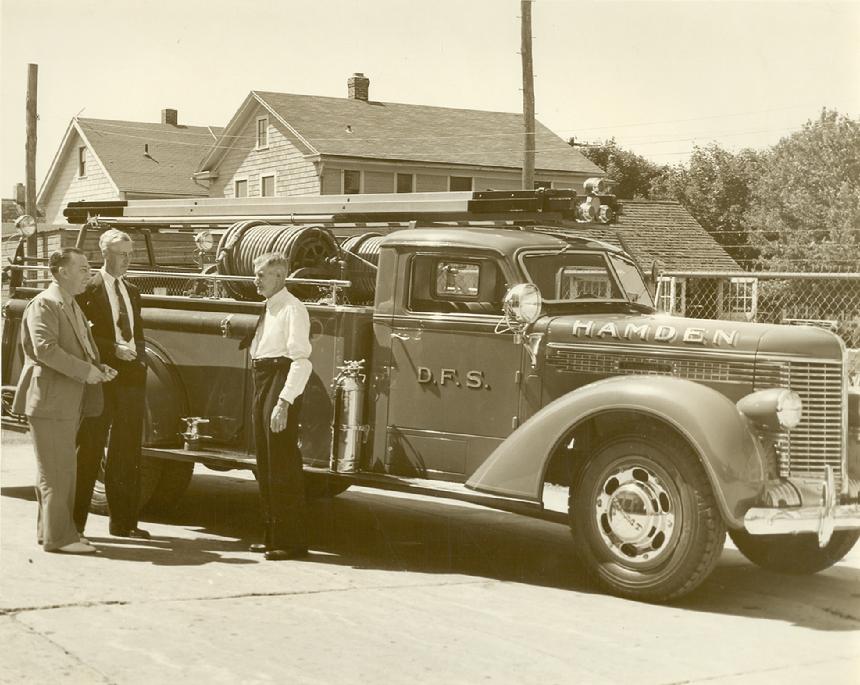
1939 Diamond-T 500
Delivered to Centerville in June 1939
|
June 13, 1939 - Ploaced in service as Engine 4, Hamden's new Diamond-T 500 GPM pumper from the Woods Engineering Co. of Topsfield, Massachusetts is inspected by two commissioners and Chief Loller. The Seagrave canopy cab pumper, delivered the year before, was transferred to Station 2.
The shorter gentleman at the left is not identified, but believed to be Commissioner Albert Ruwet. The taller gentleman is Commissioner Thomas Miller, who was a life member of the Mt. Carmel Volunteer Fire Co.
|
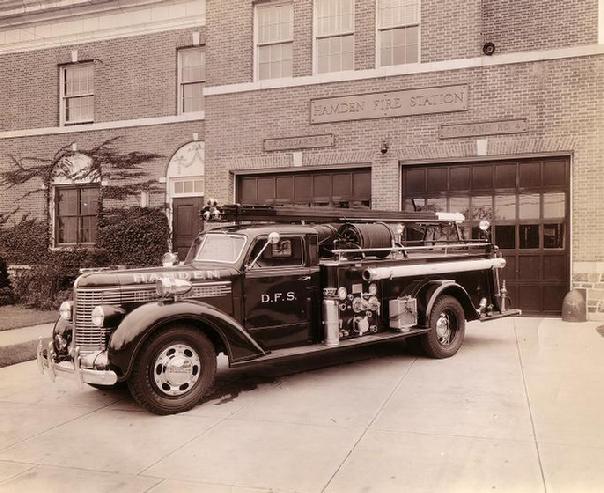 |
| 1940 - 1939 Diamond-T 500 GPM pumper |
|
|
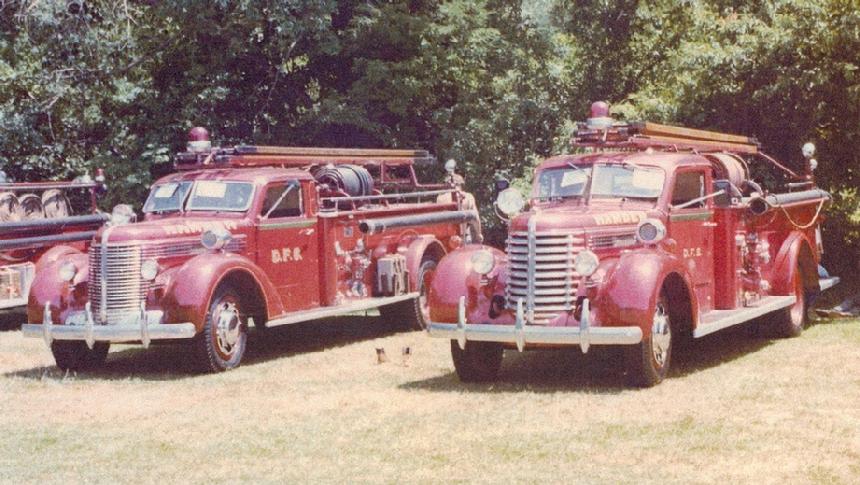 |
| Yale Field, July 3, 1977 - Hamden's 1939 Diamond-T 500 GPM, which started out as Engine 4, and 1942 Diamond-T 600 GPM, which started out as Engine 1, just a few months after being purchased by a private buyer. It was believed that these engines were purchased to be scrapped for the brass in their pumps. However, this photo gives hope that such was not their fate. Does anyone know if either of these pieces is still around? (Photo by Bill Celentano of Box 22 Associates, New Haven) |
|
|
__________________________________________________________________________________________________________
|
 |
| CLICK to enlarge |
|
|
 |
| CLICK to enlarge |
|
|
 |
| CLICK to enlarge |
|
|
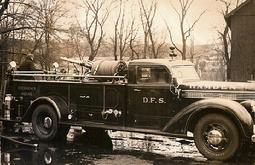
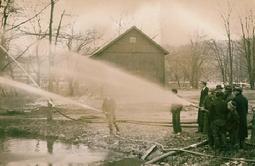
These three photos, courtesy of Gil Spencer, were labeled "testing pump, 1939, Mill River, Whitney Avenue." The two pieces of apparatus in the photos are Engine 5, a 1930 Maxim with a 600 GPM pump, and the new 1938 Diamond-T squad, which was equipped with a 150 GPM pump.
It is hard to tell from the barn and the surrounding typography of 70 years ago just where on Whitney Avenue at Mill River these photos may have been shot. They may have been taken in Mt. Carmel, between Mt. Carmel and Tuttle Avenues, or perhaps in Centerville just south of where Rt. 15 crosses today. Old streets maps show a "Whitney Lane" that ran west off Whitney about where the parkway crosses today.
|
__________________________________________________________________________________________________________
|
1942 Diamond-T 600
Delivered to Highwood in April 1942
(Pictured below at Mount Carmel in 1953)
|
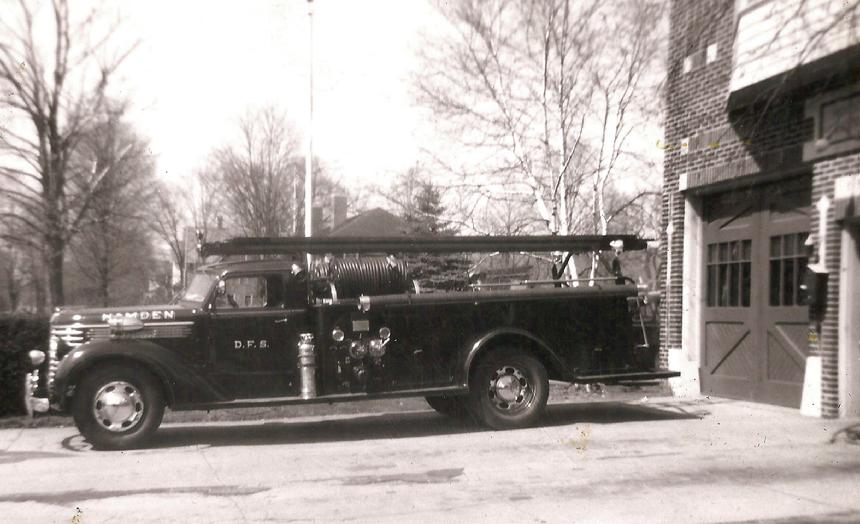 |
| 1942 Diamond-T 600 GPM pumper at Station 5 in 1953. (Photo courtesy of Tom Doherty) |
|
|
|
This 1942 Diamond-T 600 GPM pumper was purchased new by Hamden for $4,375, and was placed in service on April 6, 1942 as Engine 1 at the Highwood station. It was transferred briefly to Station 3 in October 1951, and then to Station 5 the following year.
On December 10, 1957, another 1942 Diamond-T pumper (BELOW), a 500 GPM model, was purchased from Prospect by the Dunbar Hill Volunteer Fire Co. for $1,500. It remained in service until 1977, when it was sold at auction to a priovate buyer.
|
1942 Diamond-T 500
Purchased from Prospect in December 1957
|
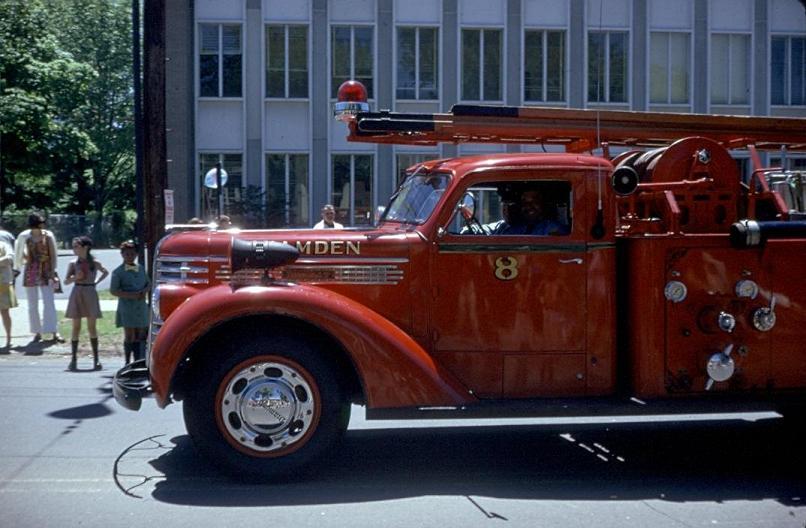 |
| Memorial Day 1970 - Co. 8's 1942 Diamond-T 500 GPM pumper, purchased from Prospect by Company 8 on December 10, 1957. This is NOT the same 1942 Diamond-T 600 GPM pumper that was purchased by Hamden in April 1942 to be Engine 1. (Photo by Ed Doiron) |
|
|
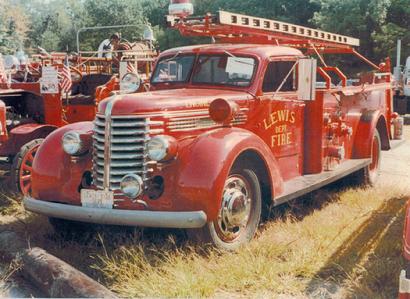
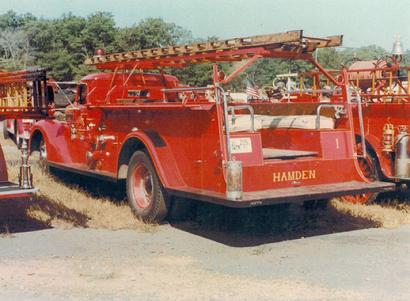
September 11, 1982 - 11th Annual Engine 260 Muster in Milford
The photos below, taken by Bill Celentano of Box 22 Associates, are of the 1942 Diamond-T 500 GPM pumper that was once Engine 8. It was purchased from Prospect in December 1957 and served as Engine 8 until 1977, when it was purchased by Dunbar Hill resident Ken Lewis - hence the name on the door. Mr. Lewis acquired several other pieces of fire apparatus, including a 1941 Diamond-T city service ladder truck, bought new by Hamden in early 1942 and sold to New Milford in 1963.
The whereabouts of both trucks is presently unknown. Does anyone know?
Posted 9/30/11
|
__________________________________________________________________________________________________________
|
1951 Maxim 750
Delivered August 1951
|
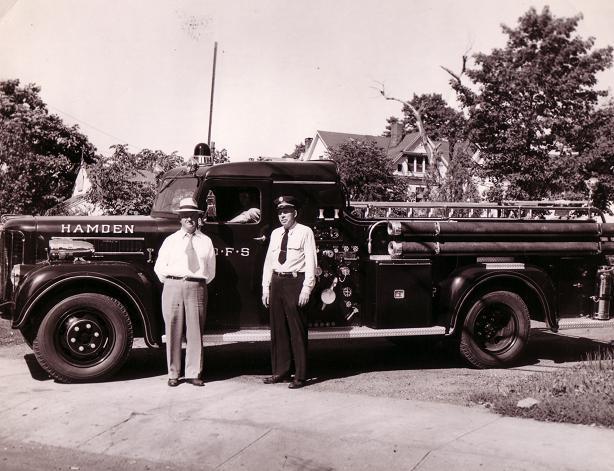 |
| Hamden's First Postwar Apparatus (Photo provided by Chan Brainard) |
|
|
Records show that the 1951 Maxim 750 was delivered on August 7, 1951. Chief Raymond C. Spencer is pictured here with Pat Monahan of the O.B. Maxwell Co. and an unidentified driver. When an identicial Maxim 750 was delivered in August of 1952, the 1951 Maxim was transferred to Station 3 (see the two photos below).
This exact location of this photo is unclear, but it is probably the driveway apron of Station 2. Station 2 would have been in the process of renovation in anticipation of the October 1951 closing of the Highwood station, and the Scott Street library is not built yet.
|
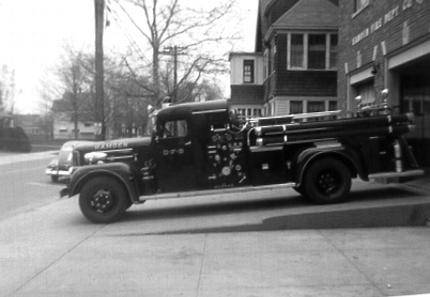 |
| These two photos of the 1951 Maxim 750 GPM pumper were taken after this piece was transferred to Station 3 on August 4, 1952. This was the first Maxim apparatus purchased by Hamden since 1930. Nine more Maxims would follow in the next 23 years. |
|
|
 |
| Chan Brainard photo |
|
|
The above two photos were taken after this piece was transferred to Station 3 on August 4, 1952. This was the first Maxim apparatus purchased by Hamden since 1930. Nine more Maxims would follow in the next 23 years.
|
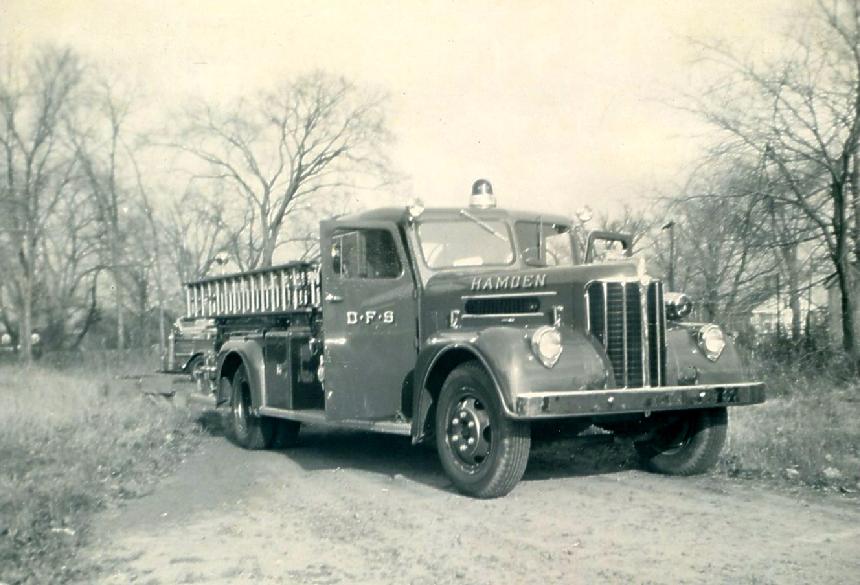 |
| 1951 Maxim on the scene in 1954 (Photo by Chan Brainard) |
|
|
|
WHERE ARE THEY NOW?
CLICK on the photo at left to see pictures of our 1951 Maxim today.
CAUTION: VIEWER DISCRETION IS ADVISED.
|
__________________________________________________________________________________________________________
|
1952 Maxim 750
Delivered August 1952
|
July 28, 1952 - M.A. Shaw (in the center), president of the Maxim Company of Middleboro, MA, presents the keys to Hamden's newest pumper to First Selectment Leon A. Booth (second from left). The gentleman on the far left is Commissioner Herbert Hume, who would succeed Booth as First Selectman the following year.
To the right of Mr. Shaw are Chief Raymond C. Spencer and Firefighter Wilbur Baker, who would be the first driver of this new piece of apparatus.
|
1957 - The 1952 Maxim 750 GPM pumper on the ramp at Station 2
This pumper was replaced by the new 1959 Maxim "cab-forward" on July 29, 1959, at which time the 1938 Diamond-T Squad at HQ was removed from service. The 1952 Maxim was assigned as "the Squad" out of Headquarters until the new 1960 Travelal was placed in service at HQ on February 9, 1960. The 1952 Maxim was then assigned to Station 5 as Engine 5. (Photo courtesy of Chan Brainard)
|
__________________________________________________________________________________________________________
|
1954 Maxim 750
(Civil Defense)
Delivered October 1954
|
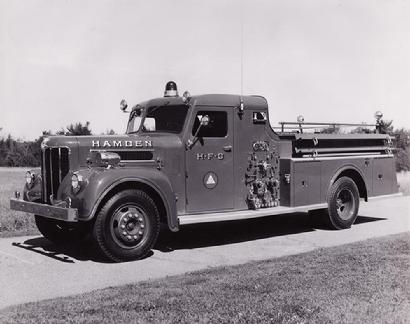 |
| 1954 Maxim Factory Photo (CLICK to enlarge) |
|
|
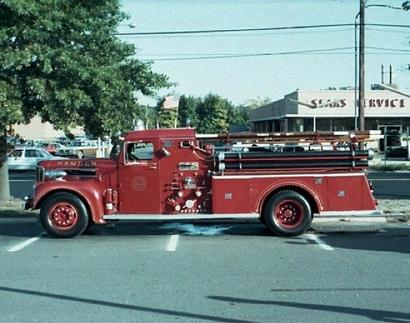 |
| 28 Years Later! Looking just as nice. (CLICK to enlarge) |
|
|
On the left is the delivery photo of Hamden's 1954 Maxim 750 GPM pumper. It was placed in service at Headquarters on October 3, 1954. Half of the $16,968 cost of this pumper was paid by Civil Defense, hence the "CD" logo on the door. Unlike the previous two Maxim pumpers, the 1954 had flat side compartments. The 1954 Maxim also had ten lug nuts on each of the front wheels, while the 1951 and 1952 Maxims only had six. This engine was still in service as a volunteer piece into the 1990s. (Photo provided by Chan Brainard).
On the right is a photo of the '54 Maxim taken 28 years later during the 1982 Fire Prevention Week Demonstration at the Hamden Mart. With the possible exceptions of the loud speaker and dedication plaque (not yet installed when the earlier picture was taken), the pumper looks almost like a delivery photo, too. The "CD" logo was removed when the pumper was repainted in 1969. (Photo by Ed Doiron, Jr.)
In the background is the old Sears Automotive Center, which stood between the main Sears building and the old Burger King opposite the Mart until it was demolished in 1994.
|
 |
| October 1954 - New Maxim Delivered to Station 2 (from 1955 Annual Report, Town of Hamden,) |
|
|
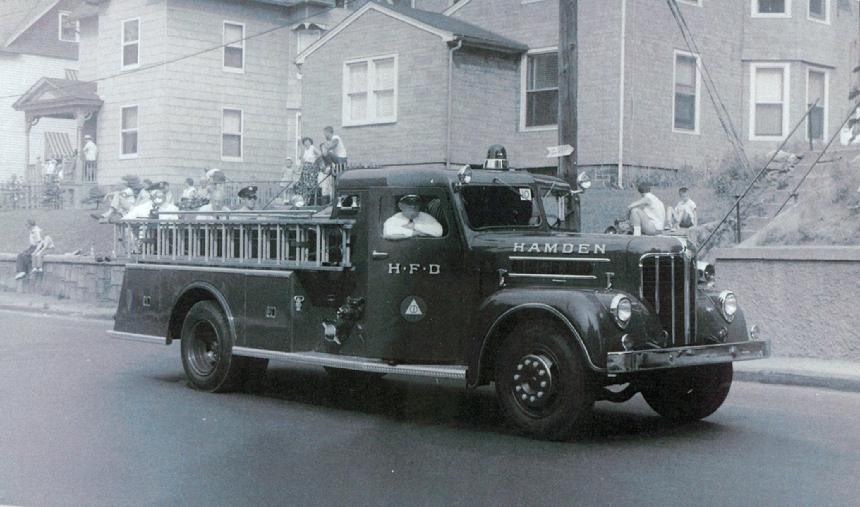 |
| 1955 - B/C Everett Doherty in Hamden's brand new Maxim 750 pumper in a Connecticut State Firemen's Convention Parade - location might be West Haven (Photo courtesy of Chan Brainard) |
|
|
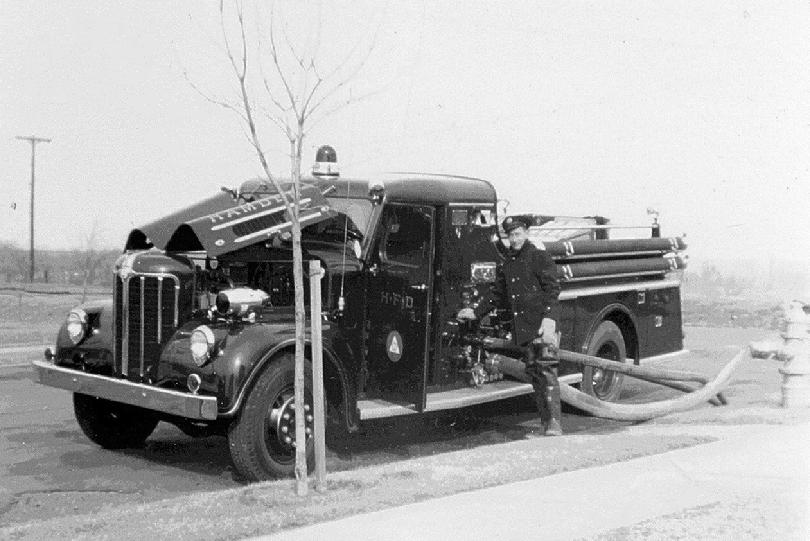 |
| January 1955 - Firefighter Bill Hines pumping with the new 1954 Maxim 750 pumper. Bill was promoted to lieutenant the following year and was still an active department member when he passed away in May 1979 following a brief illness. (Photo by Thomas Waite) |
|
|
__________________________________________________________________________________________________________
|
Fire Prevention Week Display
October 1954
|
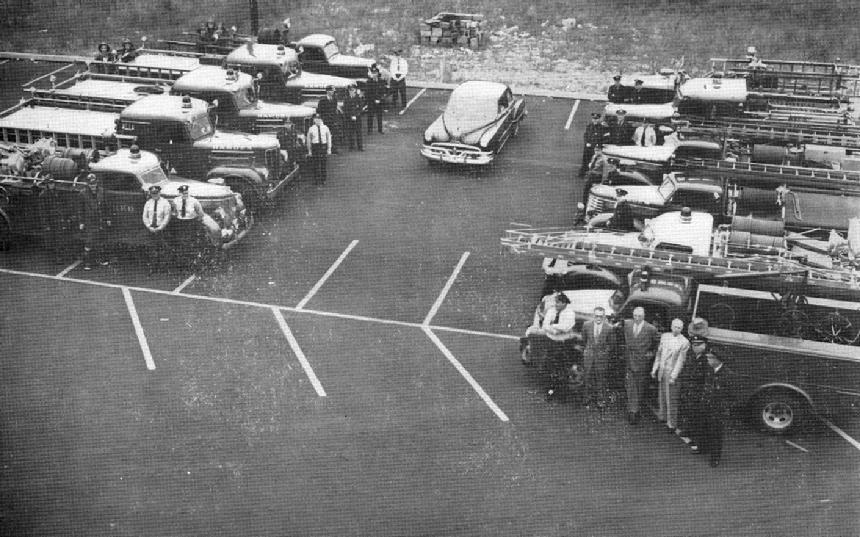
Photo taken in conjunction with Fire Prevention Week 1954 - Clockwise from the lower left: 1938 Diamond-T Squad, Engine 4 (1954 Maxim), Engine 2 (1952 Maxim), Engine 3 (1951 Maxim), Engine 7 (1935 Dodge), 1951 Pontiac (Chief's Car), Spare (1930 Maxim), Engine 1 (1938 Seagrave), Engine 6 (1939 Diamond-T), Engine 5 (1942 Diamond-T), Hook and Ladder (1941 Diamond-T ladder truck), 1952 Dodge utility truck.
Personnel in lower right: Supt. C. Wetmore, Commissioners, Marshal Purce, Chief R.C. Spencer.
|
__________________________________________________________________________________________________________
|
1959 Maxim 750 "Cab Forward"
Delivered August 1959
|
In 1915, the Whitneyville Volunteer Fire Association purchased Maxim's first motorized pumping engine. Forty-four years later, the Hamden Fire Department purchased Maxim's first "cab-forward" pumper, a Model F-2617-C 750 GPM pumping engine, for $19,135.
This pumper was delivered painted white on June 29, 1959 and was Engine 2 for most of its active days. In 1971, it was repainted "Maxim red" along with the 1958 junior aerial truck. In 1974, it was reassigned to Station 3 as Engine 6, which had become the designation for the Department's spare. In 1981, it was repowered with a diesel engine. On January 24, 1995, the 1959 Maxim "cab-forward" was retired from service. (Photo courtesy of Chan Brainard)
|
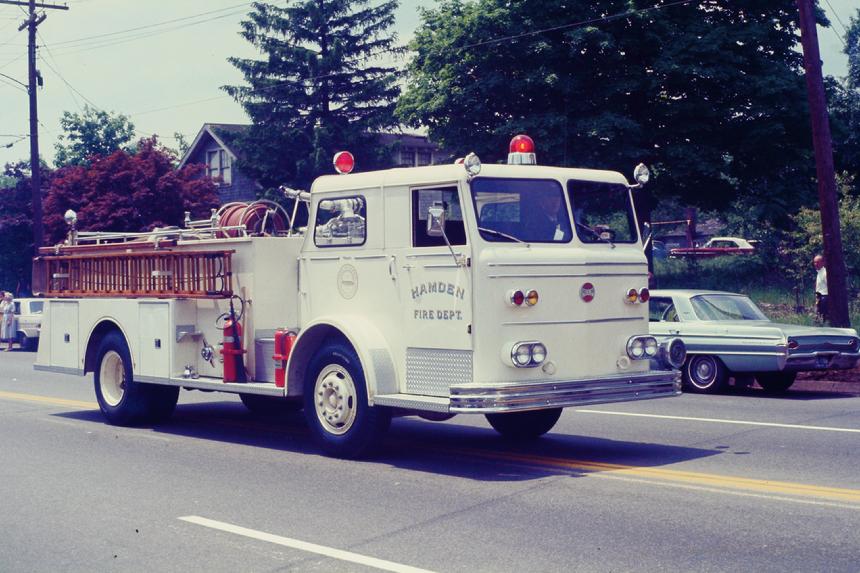 |
| Memorial Day 1966 - 1959 Maxim 750 GPM "Cab-Forward" (Photo by Ed Doiron) |
|
|
With the 1959 purchases of the Maxim 75' "Junior" aerial ladder and the first International Travel-al rescue, the Board of Fire Commissioners began ordering Hamden's apparatus in white, just like the department's neighbor to the south.
Hamden went back to red apparatus with the purchase of the 1965 Mack 750 GPM pumper. Ever since the 1984 purchase of two identical Pierce Dash 1000 GPM pumpers, Hamden pumpers and trucks have sported red bodies with white cab roofs.
|
__________________________________________________________________________________________________________
|
1965 Mack 750
Delivered August 1965
|
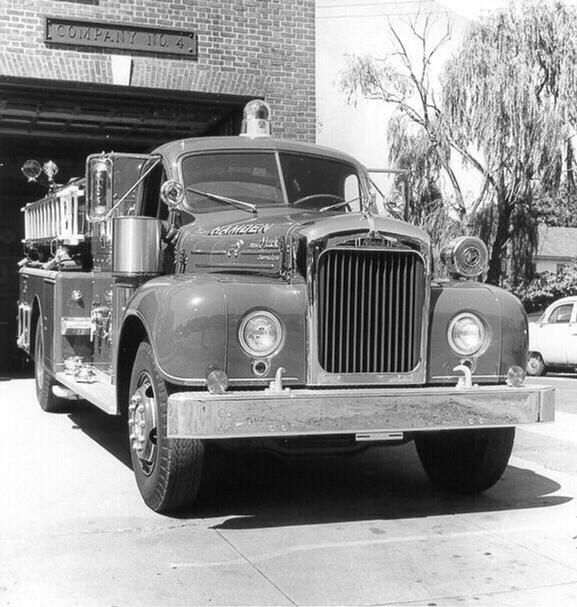 |
| 1965 Mack 750 GPM pumper |
|
|
1965 Mack 750 GPM pumper was the first new apparatus purchased after HFD went back to red. It was first placed in service temporarily as Engine 2 on August 18, 1965 while the '59 cab-forward was being repaired. It was then permanently assigned to Headquarters as Engine 4.
The '65 Mack was Hamden's first new full-size apparatus on a commercial chassis since the Diamond-Ts that were purchased before World War II, and it is the last to date. The '65 Mack served as Engine 4, Engine 2, Engine 5, Engine 9 and Engine 7 before being retired in 2000.
|
__________________________________________________________________________________________________________
|
1968 Maxim 1000 S-Models
Delivered October 1968
|
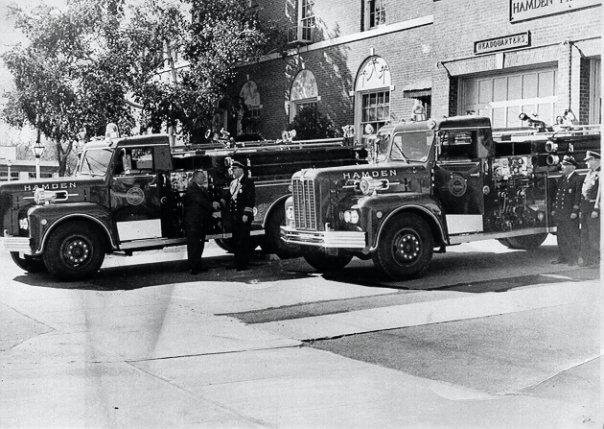 |
| November 4, 1968 - Two new Maxim S-model 1000 GPM pumpers on display at Hamden Fire Headquarters |
|
|
In the above photo, Mayor William Adams presents two 1968 Maxim Model-S 1000 GPM pumpers to Chief V. Paul Leddy, while Dep. Chief Training Officer Daniel Hume and Supt. of Alarms and Apparatus Clem Wetmore look on. The new pumpers were designated Engine 3 and Engine 4. A portion of the CITGO gas station that once stood on the southwest corner of Whitney and Dixwell can be seen in the background. The building was razed in the early 1970's to make way for Adams Park and the fountain located there.
The two pumpers were absolutely identical except for their serial numbers. In 1974, both pumpers were transferred to Station 2, as Engine 1 (#2686) and Engine 2 (#2687). Serial #2686 remained as Engine 1 to the end. Serial #2687, coincidentally the same number as the HFD union's IAFF local, was reassigned as Engine 5 in 1984. Due to the potential for long supply line lays in the north end, the bed of #2687 was reconfigured to accommodate 1,800 feet of LDH.
|
 |
| Date unknown, but probably after 1973. Nice b&w photo of one of the two 1968 Maxim S models parked in front of the bay marked "Engine 1," which actually was the bay for Engine 2, as it was (is) somewhat wider than the other two bays at Station 2. |
|
|
 |
| Serial #2687 on the ramp at 4's for a stand-by in 1994 with Ff. Jim Dunlop, it was now Engine 5, packed with 1,800' of LDH. (CLICK either photo to enlarge) |
|
|
 |
| Dedication plaque from one of the two 1968 Maxim 1,000 GPM S-Model pumpers. It is not known which pumper this came from. (CLICK to enlarge) |
|
|
| WHERE ARE THEY NOW?
CLICK on the photo at left to see pictures of one of our 1968 Maxims today.
CAUTION: VIEWER DISCRETION IS ADVISED.
|
__________________________________________________________________________________________________________
|
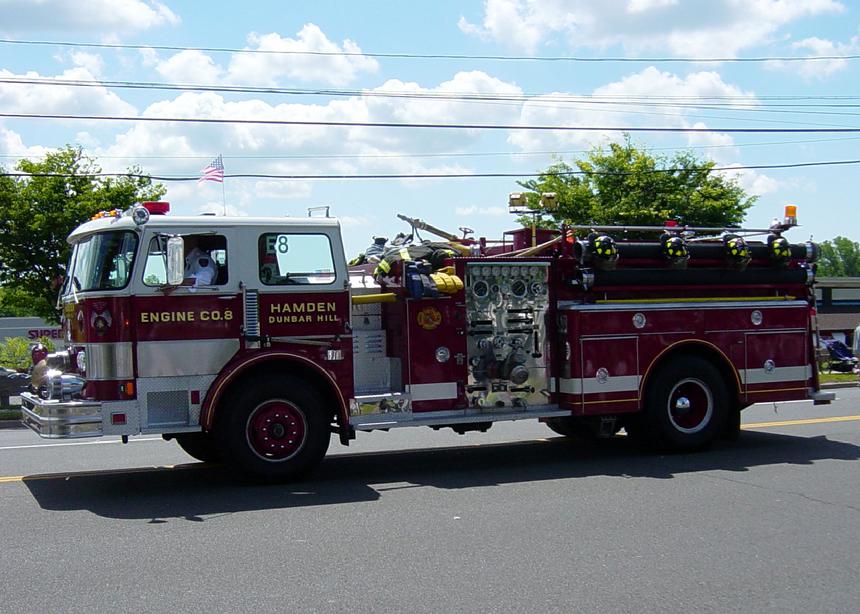 |
| Engine 8 - 1973 Hahn - May 30, 2005 |
|
|
__________________________________________________________________________________________________________
|
1973 Maxim 1000 Foam and Telesqurt Pumpers
Delivered February and March 1974, respectively
|
 |
| CLICK for enlargement w/details |
|
|
 |
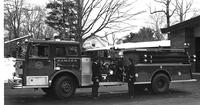
| April 1974 - Chief V. Paul Leddy and Mayor Lucien DiMeo pose in front of Station 4 with the two new Maxim pumpers that were delivered in early 1974. The Telesqurt (Engine 3) is on the left. The foam truck (Engine 4) is on the right. Both pumpers were in service for about 25 years. |
|
|
 |
| CLICK for enlargement w/details |
|
|
 |
| CLICK for enlargement w/details |
|
|
Although these pumpers arrived in 1974, delivery documents indicate that they were 1973 models. These would be the last of ten postwar purchases from Maxim.
In the large photo above, Engine 3 is on the left. It was a Maxim 1000 GPM "Telesqurt" (Chassis Model FFC 7510-C), powered with a 320 h.p. Cummins diesel engine. The telesqurt was operated from the rear step. It was placed in service at Station 3 on April 1, 1974.
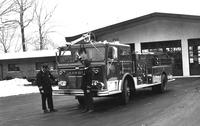
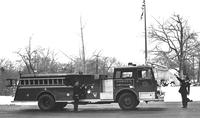
On the right is Engine 4, a Maxim 1000 GPM pumper (Chassis Model FFC 7510-C) powered with a 320 h.p. Cummins diesel engine. It was equipped with a foam delivery system consisting of an onboard foam bladder that was suspended inside the tank, a cab-mounted turret nozzle that could be operated from inside the cab, and a pair of ground sweeps mounted beneath the front bumper. This pumper was specially equipped so that it could pump and roll at the same time. It was placed in service at Station 4 on February 7, 1974.
The three photos on the left (CLICK to enlarge) are of Engine 4 when it was delivered to Station 3 in February of 1974. Engine 4 was originally intended to be Engine 3 because of Station 3's proximity to the tank farm on Welton Street. The Telesqurt was was supposed to be Engine 4. But the truck was much too big to fit inside Station 4, so it was assigned to at Station 3.
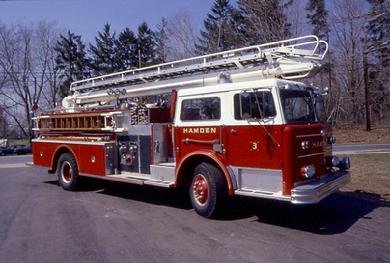
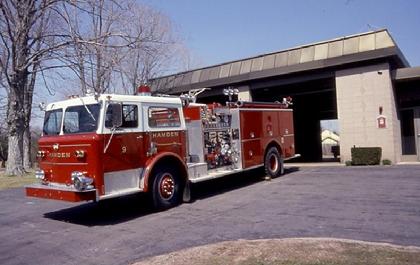
After two new 1000 g.p.m. Pierce "Dash" pumpers were delivered in December 1984, the Pierce Co. of Appleton, Wisconsin rebuilt both of these 1973 pumpers. Each received a new body with high-side compartments, and a new two-tone paint job. The "Telesqurt" returned to service as Engine 3. The foam delivery system on Engine 4 was removed and it went back in service as Engine 9. Both pieces remained in service until the late 1990s. Just why the front bumper is missing from the "new" Engine 9 in the 1985 photo (below on the right) is a mystery.
|
 |
| 1973 Telesqurt rebuilt and back as Engine 3. The new high-side compartments are on the driver's side. |
|
|
 |
| Old Engine 4 rebuilt and back in service as Engine 9 |
|
|
 |
| Photo by Ed Doiron, Sr. |
|
|
At first glance, the apparatus in the foreground in this summer 1974 photo looks like Engine 3, the 1973 Maxim Telesqurt. But the cab-mounted turret nozzle says otherwise. It's Engine 4, Hamden's 1973 Maxim 1000 GPM pumper with the foam delivery system. The Telesqurt is parked right behind. The older Maxim is Engine 5, the 1954 750 GPM. The flatside compartments (not visible in the photo) and the 10 lugnuts on the front wheels distinguish this pumper from the almost identicial 1951 and 1952 models.
The apparatus are parked just inside the Dixwell Avenue parking lot to the old Centerville School (now the Miller Library), where the Fire Chief's Office had been relocated a few months earlier. Previously, the Chief's Office was on the second floor of the town hall right above the north entrance just south of Station 4.
CLICK this photo to see why these engines were parked there.
Posted 6/10/11
|
__________________________________________________________________________________________________________
|
1978 Pierce 450 Mini-pumper on Ford Chassis
Delivered Summer 1978
|
 |
| 1978 Pierce Mini-Pumper on Ford F350 Chassis - 450 GPM pump (Photo by Ed Doiron) |
|
|
__________________________________________________________________________________________________________
|
1984 Pierce Dash 1000 GPM Pumpers
Delivered December 1984
|
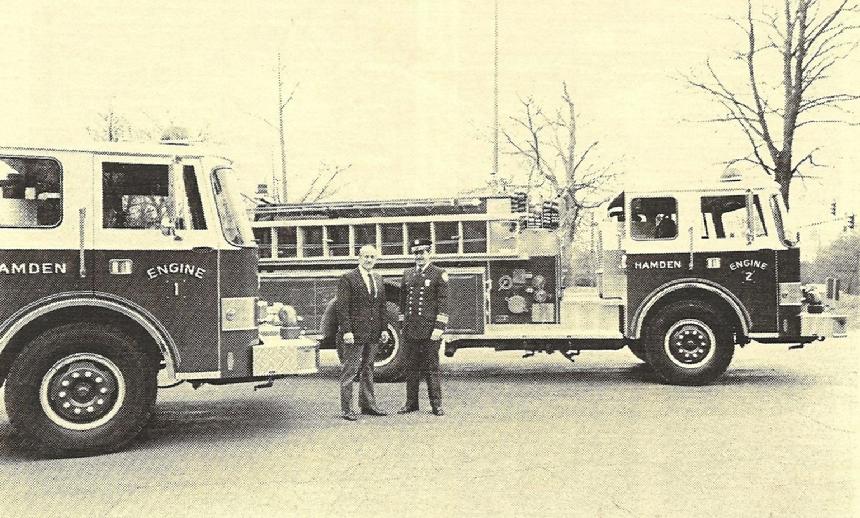 |
| December 1984 - Mayor Peter Villano and Chief John Tramontano with brand new twin 1984 Pierce Dash 1000 GPM pumpers |
|
|
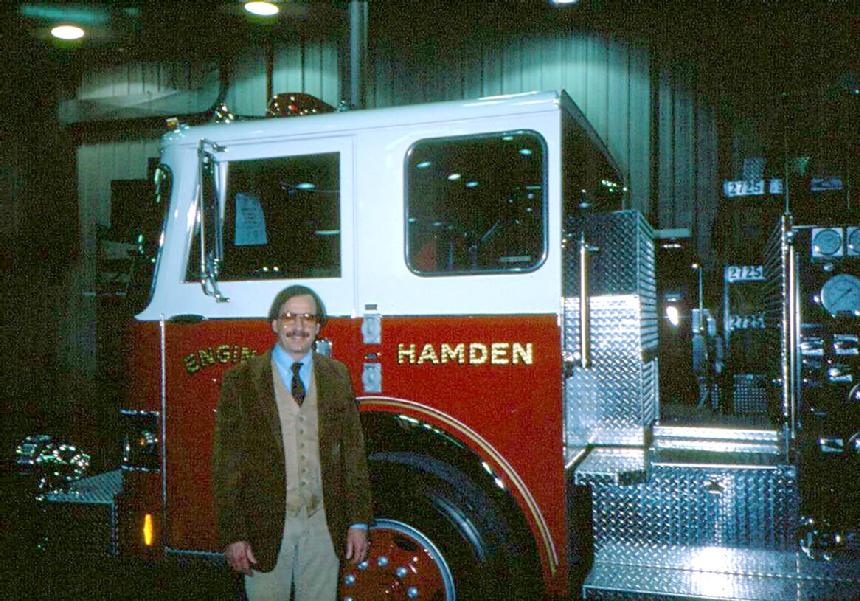 |
| November 1984 - Chief John Tramontano poses with one of two new Pierce Dash 1000 GPM pumpers at the Pierce factory in Appleton, Wisconsin. |
|
|
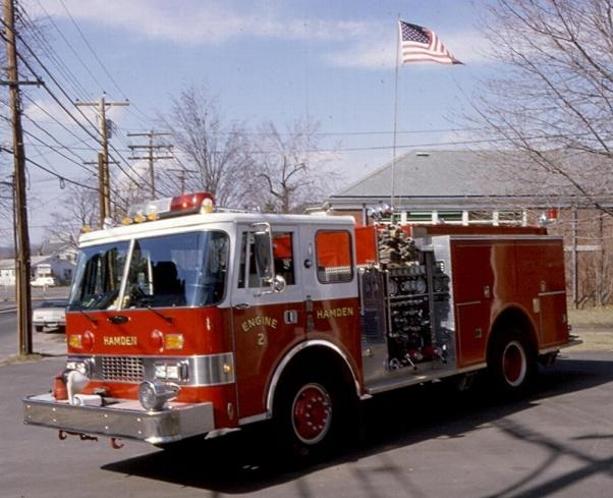 |
| March 1985 - Engine 2, a 1984 Pierce "Dash" 1000 GPM pumper on the ramp at Station 2. One of two identical pumpers delivered in December 1984. CLICK on this photo to see this pumper as it is today! |
|
|
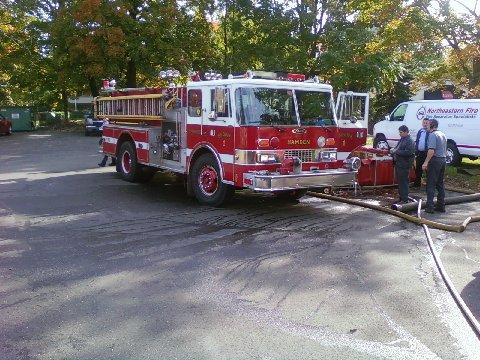 |
| Date Unknown - Engine 2 drafting from a portable pond, perhaps during training exercise. (Photo courtesy of Lt. Joe Anderson) |
|
|
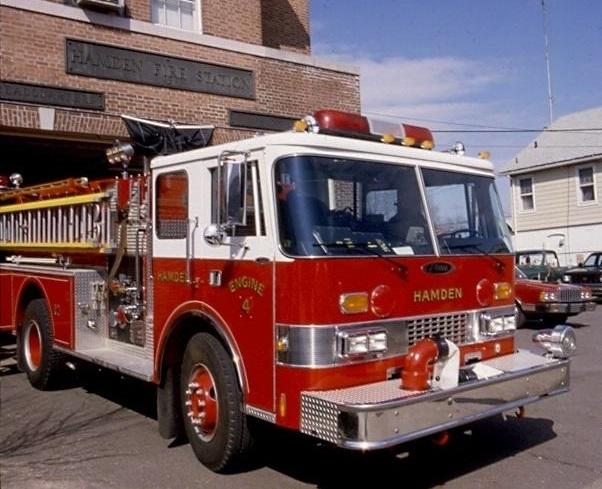 |
| March 1985 - Engine 4, a 1984 Pierce "Dash" 1000 GPM pumper on the ramp at Station 4. One of two identical pumpers delivered in December 1984. |
|
|
__________________________________________________________________________________________________________
|
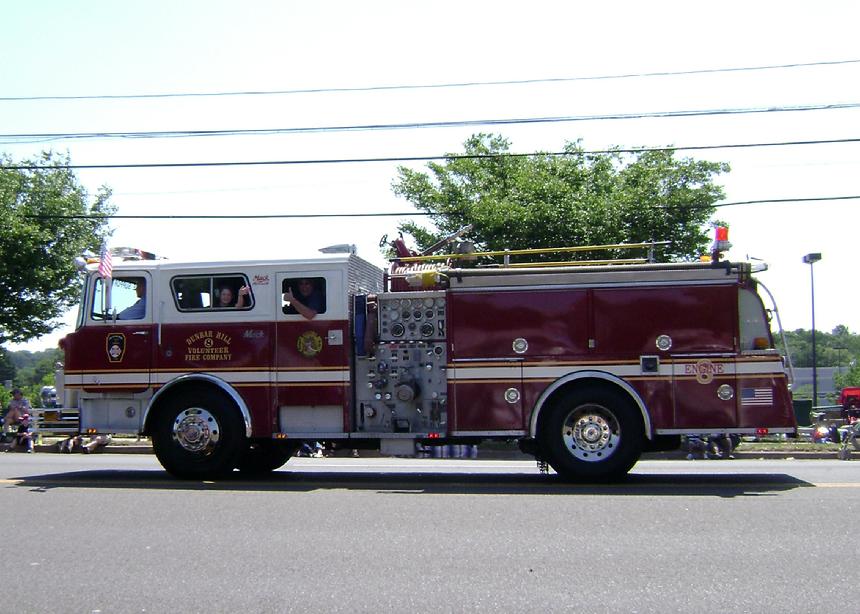 |
| Engine 8 - 1984 Mack CF - May 31, 2010 |
|
|
__________________________________________________________________________________________________________
|
 |
| Engine 7 - 1990 FMC Ford - May 30, 2010 |
|
|
__________________________________________________________________________________________________________
|
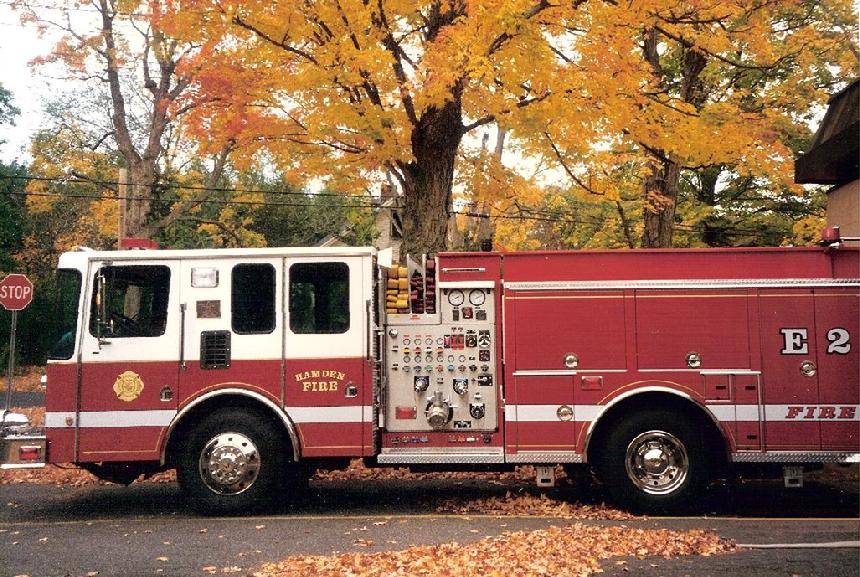 |
| October 23, 1997 - Engine 2 - 1997 3D HME 1250 GPM with 750 gal. tank and Class A foam (Photo courtesy of Tim Sullivan) |
|
|
__________________________________________________________________________________________________________
|
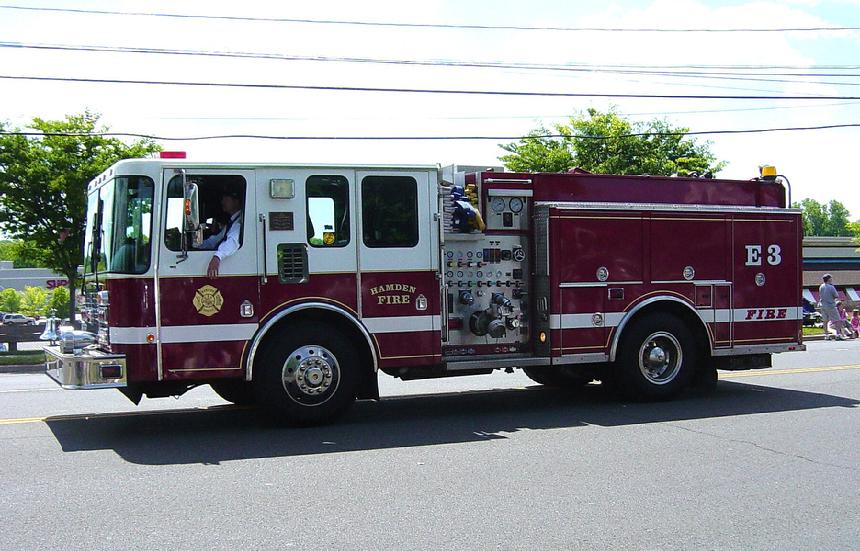 |
| Engine 3 - 1999 3D HME 1250 GPM pumper - May 30, 2005 |
|
|
__________________________________________________________________________________________________________
|
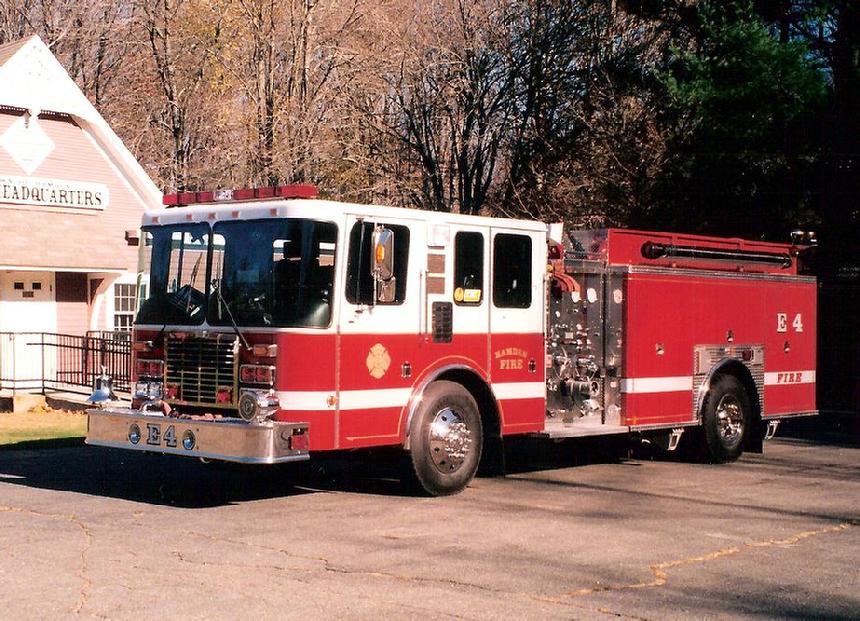 |
| Engine 4 (Now Engine 9) - 2001 Marion HME 1500 GPM pumper (Photo courtesy of Tim Sullivan) |
|
|
__________________________________________________________________________________________________________
|
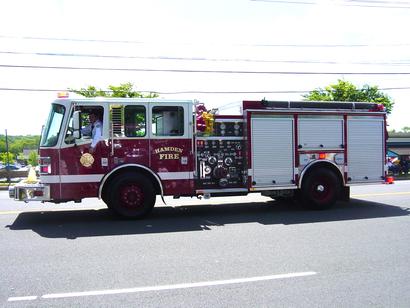 |
| Engine 5 - 2005 Ferrara Inferno 1500 GPM - May 30, 2010 (CLICK to enlarge) |
|
|
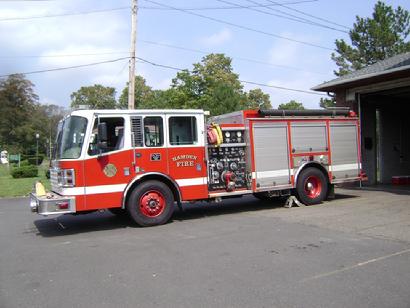 |
| Engine 5 - 2005 Ferrara Inferno - September 4, 2011 (CLICK to enlarge) |
|
|
__________________________________________________________________________________________________________
|
 |
| "The Squad" - 2008 Marion Spartan 1250 GPM - at Station 4 - September 22, 2009 |
|
|
 |
| Rear compartment of Squad 1 |
|
|
__________________________________________________________________________________________________________
|
|