|
WEATHER VANE RESTAURANT
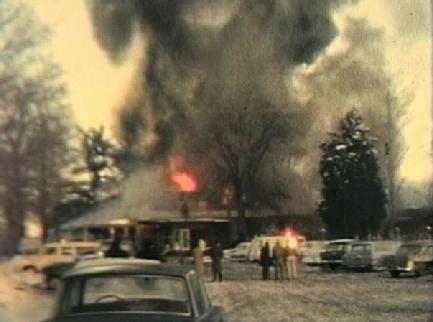
"Spectacular!" That word is often overused by news media to describe big fires. But when the Weather Vane Restaurant burned to the ground fifty years ago this week it was indeed one of the most spectacular Hamden fires of the post-WWII era. Below is an updated version of an article originally published here five years ago on the 45th anniversary of the blaze.
Revised and re-posted 12/5/14
|
|
Weather Vane Restaurant
4137 Whitney Avenue
Monday, December 7, 1964
|
 |
| Weather Vane interiors (Courtesy of Mary Jane McGaffin) |
|
Winter 1964-65 was a memorable period for the Hamden Fire Department. Fires would destroy two important Hamden restaurants in December and one radio station in late January. The first occurred on the first Monday of December.
Since 1936, the Weather Vane Restaurant had occupied the rambling 50-year old wood-frame building at 4137 Whitney Avenue, once known as the old Mount Carmel Inn. Twenty-eight years later, on the morning of December 7, 1964, the well-known Hamden landmark was destroyed in a spectacular fire that was believed to have started in the kitchen. The two young daughters of owner Claire DeMaio barely escaped with their lives as they scrambled onto a porch roof to escape the flames that prevented them from exiting their second floor bedroom.
The old Second Platoon, commanded by Deputy Chief Everett Doherty, had just come on duty for the day shift. Recruit firefighters Ed Doiron, Charlie Carlson, and Harold Mangler, who started on the job only two weeks earlier, were still in training with Deputy Chief Training Officer Dan Hume in the basement of Fire Headquarters.
Retired Battalion Chief Gil Spencer was a firefighter at Headquarters assigned to Engine 4 with Lt. Bill Hines and driver Johnny Hoffman. Firefighters Milner Benham and Paul Reutenauer were on Rescue 2, which was stationed at Headquarters in those days. Chief V. Paul Leddy and Marshal Al Purce shared a tiny office at the top of the stairs on the second floor on the north end of the Town Hall, almost where the present Chief’s Office is located.
Gil recalls that right after he reported to work that morning he was delegated to drive Chief Leddy's 1962 Rambler, Car 40, to the Shop to be gassed up and cleaned off after the snowfall the night before. Gil loaded his bunker gear into the Chief's car and headed off to the Shop as the rest of the guys at Headquarters and all the other stations began their morning chores.
The morning routines were suddenly interrupted at 8:40. The alert gong clanged once in all stations, followed by about five seconds of ringing bells. Dispatcher Wilbur Baker’s voice boomed over the station PA systems, "Engine 5, Engine 4, Rescue 2 and Ladder 1, respond on a reported building fire at the Weather Vane Restaurant." No address was necessary. Everyone on the department was familiar with the Weather Vane.
|
 |
| Dep. Chief Everett Doherty |
|
Gil Spencer parked Chief Leddy’s car by the gasoline pump at the Shop in back of Station 2. Starting his rounds in Car 30, Deputy Chief Doherty had just arrived Station 2 as Baker was dispatching the call. “You come with me,” Doherty barked to Spencer, who grabbed his gear from Car 40 for the long ride north with Doherty to the fire scene.
Gil vividly recalled riding with his shift commander in Car 30. Doherty proceeded cautiously up Circular to Cherry Hill – “the fire will still be there when we get there” - then up Benham to Mix, over to Shepard, and out to Whitney.
A “Plectron” radio system for alerting the volunteers, purchased the year before, allowed Dispatcher Baker to “tone out” the volunteers of Co. 5. The late Jim Mathis was then an 18-year old volunteer firefighter from Mt. Carmel. Retired Deputy Chief Clark Hurlburt always remembered Jim’s recollection of Engine 5’s first radio transmission when arriving at the Weather Vane. "Looks like a good 10-8!"
A seventeen-year old future Hamden firefighter was waiting for the Waterbury bus at the corner of Whitney and Carmel as what seemed like a caravan of fire apparatus flew by. Something big must be going on, he thought.
The Drillmaster was not assigned a department vehicle at that time, but Dep. Chief Hume and his three recruits got to the Weather Vane somehow. Ed Doiron does not recall just how they got there. But they all piled into someone's car, probably Hume's personal car, and off they went.
|
With Car 40 still at the Shop, the Chief had to bum a ride with Marshal Purce in Car 41, a red and white 1957 Ford. As Leddy and Purce approached the Big-Y just north of Sherman Avenue they observed the enormous column of black smoke. The Chief called for a second alarm. Engine 3 and Rescue 1 from Putnam Avenue and Engine 2 from Circular Avenue were dispatched to the scene.
A major problem for firefighters was that the fire had a good head start before it was reported. This was evidenced by the fact that the two DeMaio sisters only discovered the fire as the onrush of flames impinged on their second floor bedroom. Fire Marshal Al Purce was later quoted as saying that in his nearly forty years in the fire service "I have never seen a building so full of fire so quickly."
Another problem faced by firefighters were the subfreezing temperatures that immediately created icing hazards all over the fire scene.
The green CR&L Waterbury bus stopped at Whitney and Carmel. The seventeen-year old future Hamden firefighter got aboard and dropped his dime and quarter into the coin receptacle. His daily trip to work in Cheshire usually took about twenty minutes. A slight detour a few miles further up the road would lengthen this day’s commute.
|
 |
| Car 30 - 1961 Ford Sedan |
|
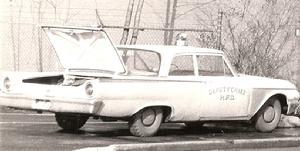
Deputy Chief Doherty and Spencer finally navigated their way to the scene in the white 1961 Ford sedan that was Car 30. When the two men pulled into the Weather Vane parking lot Chief Leddy was standing there with hands on hips. “Where’s my car?”
Spencer emerged from Car 30 with his gear, "It's still at the Shop, Chief."
Leddy was not amused. His own gear was still in the trunk of Car 40. The Chief then ordered someone from the Shop to drive his car to the fire scene.
|
 |
| Ladder 1 |
|
Firefighter and future battalion chief Tom Doherty, son of the Deputy Chief and a four-year veteran of the department, was off-duty. Just leaving Liggett’s Drug Store at the Hamden Plaza, Tom heard the deep unmistakable wail of a Federal siren approaching. Engine 2 was barreling north up Dixwell Avenue, well out of its first alarm territory.
His hand over his brow, Tom looked toward Centerville. Nothing. Turning further north, there it was. An enormous black cloud billowed skyward.
The younger Doherty drove straight to Headquarters, where he was stationed on the 1st Platoon. He parked on the ramp in front of Engine 4's vacant bay and ran to the alarm room. "It’s the Weather Vane!" said Baker, and "it's going good.” Tom grabbed his bunker gear and took off north. He remembers that when he arrived at the fire scene the flames were at about the same magnitude as in the well-known Tom Pettis color photo that graced the cover of the Sunday Register supplement a few weeks later.
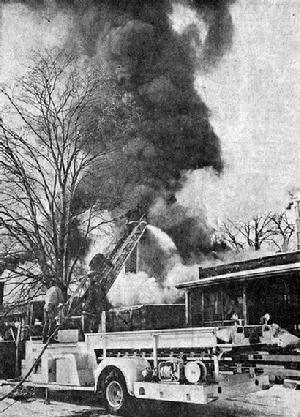
Gil Spencer recalled that Firefighters Dave Howe and Fred Fletcher manned Engine 5, which was at the hydrant near the front of the building. Engine 4 was in the parking area near the south side of the main building – it can be seen there in the 8mm home movie that is linked from this website. Firefighters Frank Eitler and Bernie Early of Ladder 1 were ordered to set up the ladder pipe on the north side of the building.
Traffic on Whitney Avenue backed up quickly. Nearing the Connecticut Donut Co., the Waterbury bus slowed to a crawl. As it inched its way around the curve just past River Road the entire conflagration came into full view of the passengers.
The future Hamden firefighter was sitting on the right-hand side of the bus. "The radiant heat could be felt by everyone on the bus,” recalled the now-retired firefighter, “Flames were coming from almost every window, leaping forty to fifty feet above the roof. It was a staggering sight, and a sad one, to see that grand old landmark go up like that."
All northbound traffic was rerouted up Brooksvale Avenue and back out to Route 10 via Mount Sanford Road.
|
 |
| Lt. William Hines |
|
The second alarm brought two more engines and the second rescue to the scene. Capt. Bob O’Donnell, Firefighters Art Smith and Paul Wetmore [Sr.] responded on Engine 2. John O'Hare recalls that he drove Engine 3 with Lt. Dan O’Connell and Firefighters Art Heriot and Ben Mikolinski. O'Hare also recalled that John Tramontano and Charlie Esposito responded on Rescue 1, then stationed at Putnam Avenue with Engine 3.
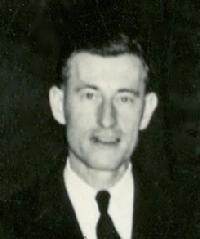
Since Engine 4 was one man short, Gil Spencer suggested that Lt. Hines was probably alone in the kitchen on his belly with an 1½” line. The only other guy on Engine 4 that day was driver Johnny Hoffman, who was operating the pump.
Lt. Bill Hines was no stranger to danger. The Weather Vane was a piece of cake compared to what Bill experienced on that date twenty-three years earlier, when the Japanese attacked Pearl Harbor. Bill Hines was in the United States Army, stationed at Schofield Barracks adjacent to Hickam Field.
The Weather Vane fire made significant headway well before the first piece arrived. Numerous interior partitions had made it very difficult to reach the seat of the fire. It was obvious that as the fire progressed it was going to be a surround and drown operation. Chief Leddy ordered everyone out of the main building.
Spencer and fellow firefighters were on 2½” lines outside, but making little progress. They eventually got permission from the brass to use the deck gun atop Engine 4, the same deck gun that was once on the 1938 Diamond T squad. Once in operation, the deck gun was probably delivering about 600 GPM.
|
 |
| 50 Years later the old Weather Vane cocktail lounge is now DeMil's. |
|
Tom Doherty spent the rest of the day at the Weather Vane. He was with a crew that did its best to save the cocktail lounge, south and rear of the main building. They were successful. The cocktail lounge was only the unburned portion of the restaurant. In 1966, the Weather Vane reopened in that portion of the building, which still stands today as part of DeMil’s Restaurant.
A pumper with a crew remained all night at the Weather Vane on fire watch, to catch small fires that developed from within the devastation.
Spencer and many other members of his platoon were back the next day to continue the fire watch. A state inspector was also there to ensure that the bottled alcoholic beverages were destroyed.
It was a miracle that Claire DeMaio’s two daughters got out of the blazing building alive. Sadly, some irreplaceable artwork by Mrs. DeMaio’s late husband and world-renowned artist, Salvatore DeMaio, was lost forever. Estimates of the loss of the building and contents were in the hundreds of thousands of dollars. And that was fifty years ago!
Contemporary newspaper accounts of the fire acknowledged that a delay in reporting the fire was probably responsible for the building being so well involved when the first fire apparatus arrived. Chief Leddy reported that the first call to reach the fire department came from “an unidentified man at 8:40 a.m.”
The New Haven Register reported that “a hysterical woman, also unidentified, reportedly called the police department 5 or 10 minutes earlier, but only said there was a fire in Mount Carmel.”
The Register also reported that fire officials said that fire apparatus responded very quickly, “but that first report [of the fire] may have been delayed because passersby and neighbors felt that someone else had already called.”
The Weather Vane’s main building was never rebuilt on the footprint of the original building. Apparently a snafu resulting from the delay of more than a year prevented the “grandfathering” of new construction as close to Route 10 as the original building was situated.
The Weather Vane was one of the most memorable fires in the annals of the Hamden Fire Department. But Tom Doherty remembers that day for another reason. It was his birthday. (First Pearl Harbor, now this!) Hard to believe, but at the time Tom was still in his twenties!
Eddy Doiron recalls that Harold Mangler, Charlie Carlson and he received plenty of on the job training during their first few weeks on the job. Only seven days after the Weather Vane fire, they responded with Dep. Chief Hume to a man trapped in a caved-in trench on Skiff Street. Regular fire crews along with the three new recruits received commendations for their valiant and successful efforts to save the man.
Eighteen days after the Weather Vane, on a balmy 70-degree Christmas Day, the department fought its next major blaze. More on that one as we get closer to Christmas of 2014.
Revised and re-posted 12/5/14
|
__________________________________________________________________________________________________________
|
The author wishes to thank and acknowledge Chief Paul Wetmore Sr., D/C Clark Hurlburt, B/C Tom Doherty, B/C Gilbert Spencer, Ff. John O'Hare, Ff. Ben Mikolinski, and Ff. Ed Doiron for their assistance in the preparation of this article.
Eleven individuals at the Weather Vane fire fifty years ago are still with us today in 2014: Milner Benham, Charles Carlson, Tom Doherty, Ed Doiron, Harold Mangler, Ben Mikolinski, John O'Hare, Gilbert Spencer, John Tramontano, Paul Wetmore Sr., and article author Dave Johnson, who will never forget the bus ride.
12/5/2014
|
__________________________________________________________________________________________________________
|
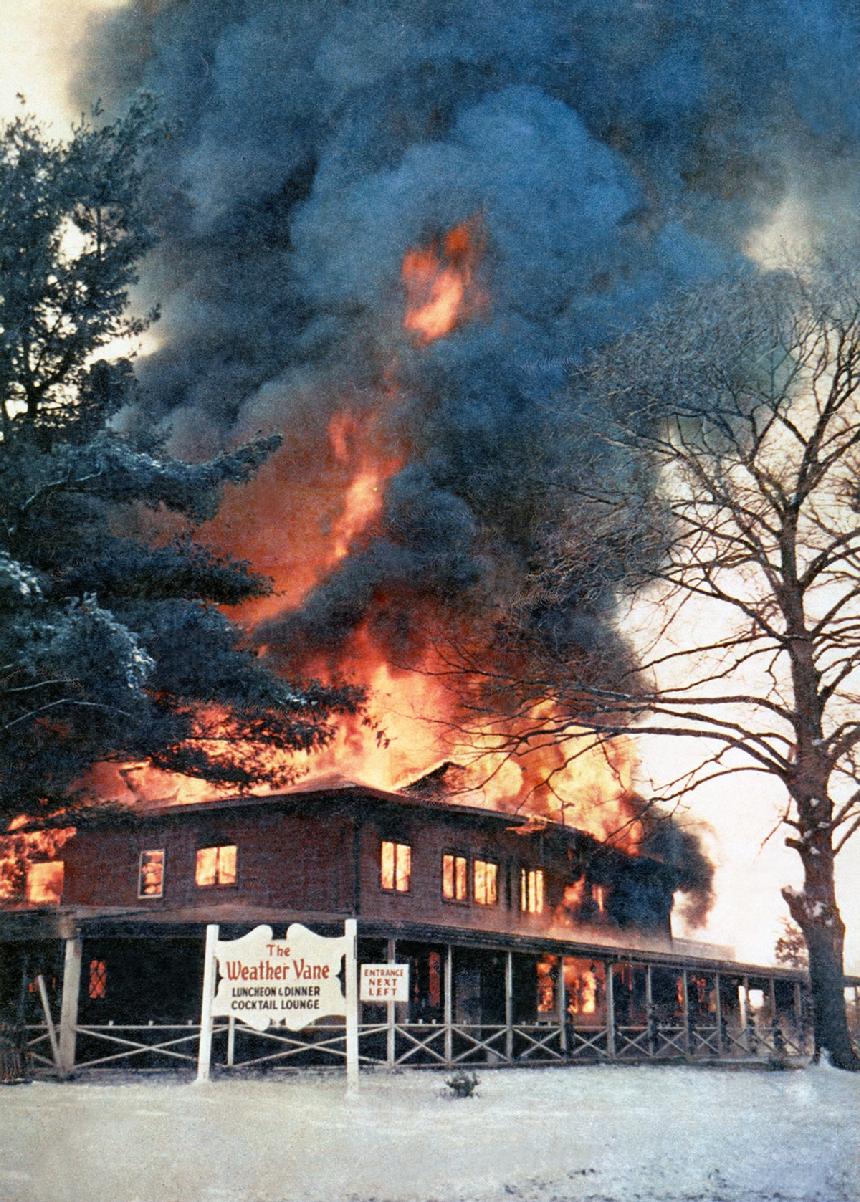 |
| Weather Vane Restaurant - December 7, 1964 (Photo by Joseph Pettits, © 1964 - New Haven Register) |
|
|
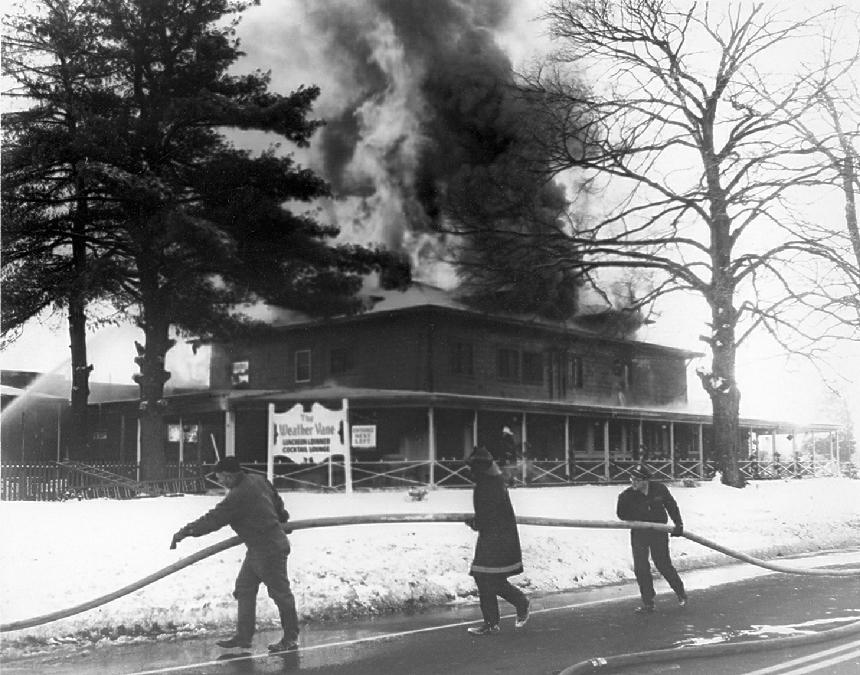 |
| A civilian, Hamden firefighter and Johnny Murray (Murray's Ambulance Service) help stretch a 2-1/2" line toward the north end of the building. (I.A. Sneiderman photo courtesy of Brian Leddy) |
|
|
 |
| (Photo credited to Mongillo Studio, 52 Crown Street, New Haven) |
|
|
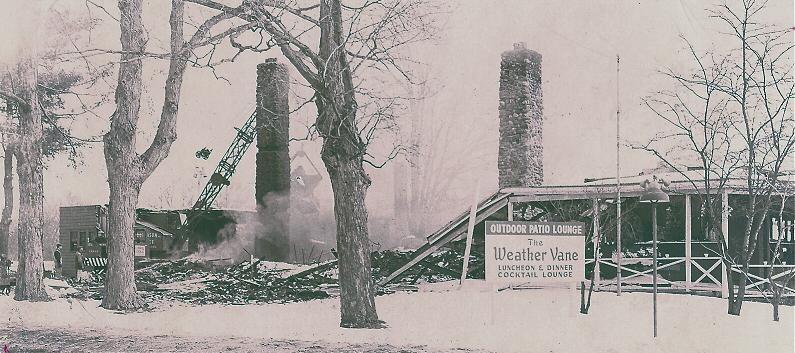 |
| This photo by John Mongillo, Jr. appeared on the front page of the New Haven Register the next day, with the following caption "Requiem for a well-loved inn. Blackened bones of Weather Vane." |
|
|
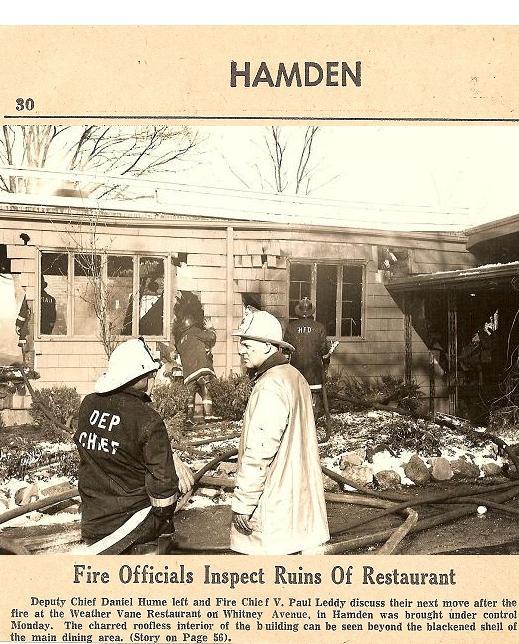 |
| © New Haven Register - December 8, 1964 (Courtesy of G. Donald Steele - Photo by John Mongillo, Jr.) |
|
|
 |
| © The New Haven Register - Tuesday, December 8, 1964 (Articles courtesy of G. Donald Steele) |
|
|
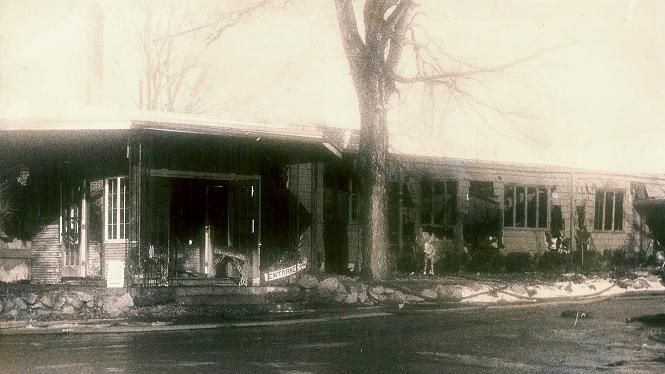 |
| Aftermath |
|
|
Weather Vane Restaurant Fire
Monday, December 7, 1964
Gil Spencer has provided an 8mm home movie, taken by his uncle, Harold Spencer of Hamden, of the December 1964 fire that destroyed the Weather Vane Restaurant. The Weather Vane was a well known landmark that stood just past Brooksvale Avenue on the east side of Whitney Avenue.
The movie has been digitally transcribed and is now available on YouTube. Click on the photo at right to watch the YouTube video.
|
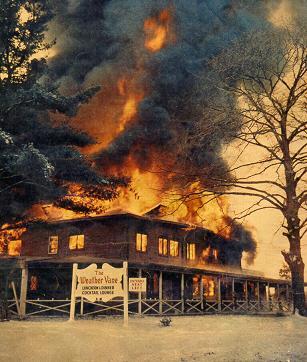 |
| CLICK photo to view video (Photo by Joseph Pettis) |
|
|
|