|
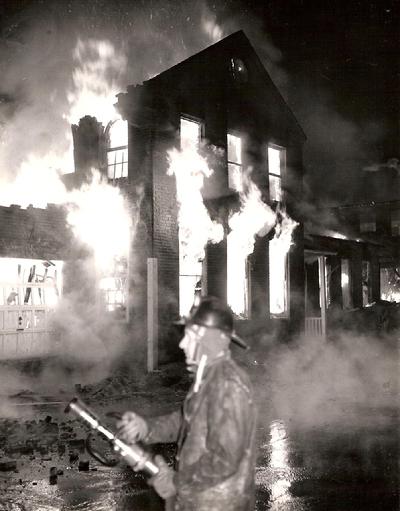
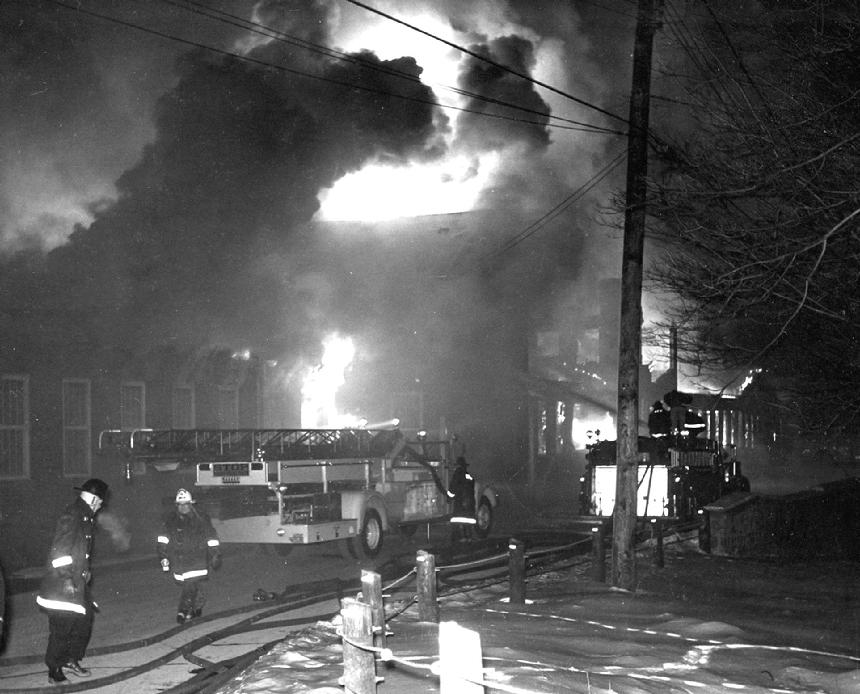
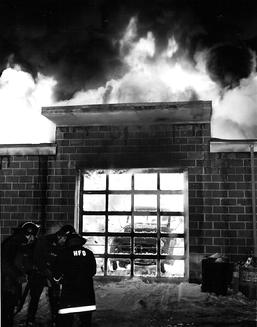
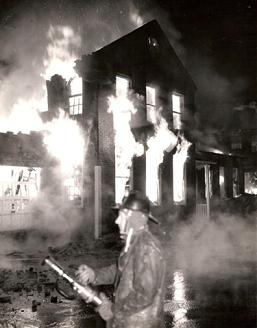
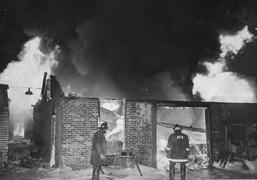
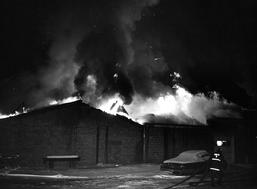
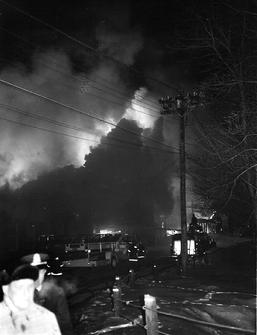
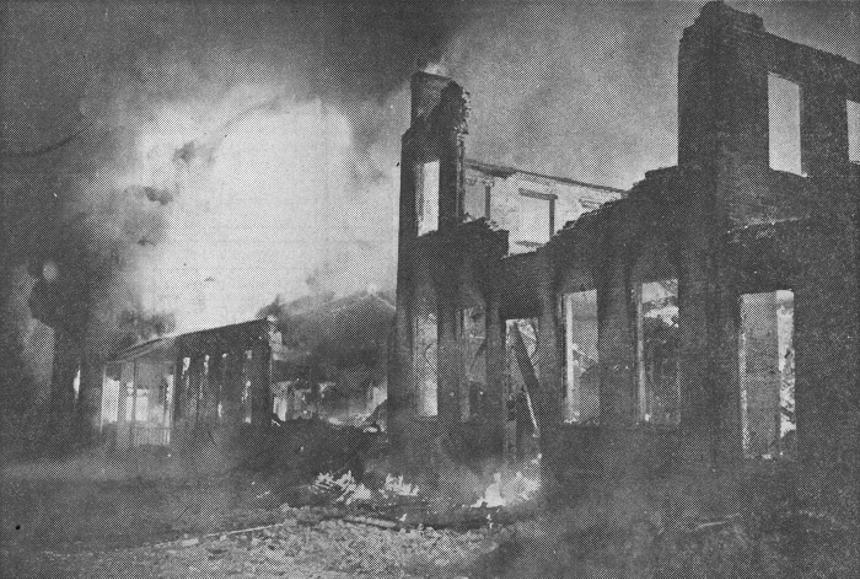
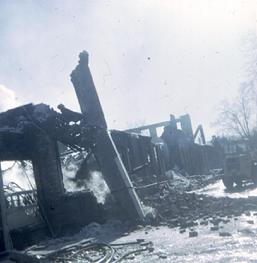
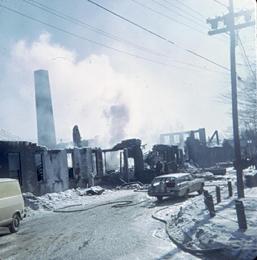
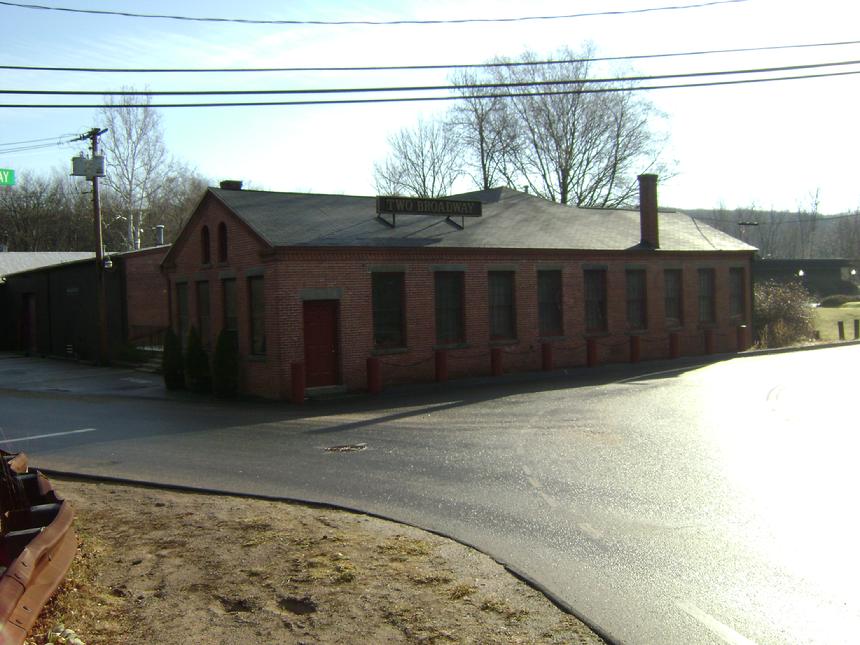
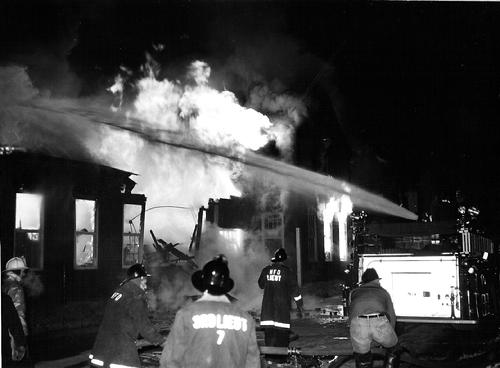
Fleming Co., Broadway at Ives Street Friday, January 12, 1968
|
Major fire launches a transitional year for the Hamden Fire
Department
(Originally published on the Local 2687 website in January 2008)
Unless otherwise noted, all black and white photos below are by John Mongillo, Jr.
It has been forty years, but Jean Law will never
forget the early morning hours of Friday, January 12, 1968, when she was
wakened by loud voices outside her South New Road home. Peeking out her front picture window, Jean
didn’t see any people, only a huge orange glow reflecting on the houses across
the street. But it was a different
story when she looked out her rear window, through the leaf-bare trees across
Mill River to Broadway. Now well into
her eighties, Jean easily recalls how she sat by the window that morning,
watching one of the most spectacular blazes in Hamden history.
|
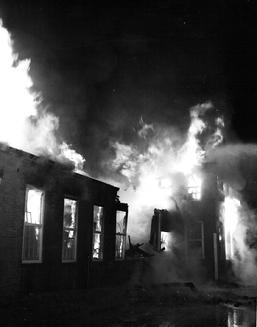
According to newspaper accounts, as
well as recollections from firefighters who were there, a truck driver heading
north on Ridge Road at about 3:45 that morning noticed a glow in the sky. Checking it out, the man drove his truck
down Broadway to the George W. Fleming Co., where he found the south end of the
rambling 133-year old brick building fully involved. He was the only spectator.
The
truck driver then raced up Ives to Whitney and pulled onto the ramp at Station
5. In those somewhat simpler times
Hamden firehouses were always unlocked, so the guy had no trouble getting
inside. He ran to the watch desk,
picked up the “house phone” and began barking “Fire!” over the loud speakers of
every fire station in town.
Firefighters
Mario “Bucky” Serafino and Gerry Wolf, who had been asleep upstairs at Station
5, were able to relay further details to dispatcher Wilbur Baker over the
inside PBX line. Baker immediately
dispatched Bucky and Gerry on Engine 5, as well as Engine 4, Ladder 1 (at
Station 2), Rescue 2 (at Station 4), and then “toned out” the volunteers of Co.
5.
The New Haven Register
reported, “When the first company reached the scene, the fire was surging
through the roof and lashing along the sides of the structure.” Fire Chief V. Paul Leddy had no trouble
seeing the conflagration from his Cumpstone Drive home. He immediately ordered a second alarm, which
brought Engine 2 from Station 2, Engine 3 and Rescue 1 from old Station 3 on
Putnam Avenue, as well as additional volunteer companies 7 and 9. North Haven dispatched a pumper from their
West Ridge station.
|
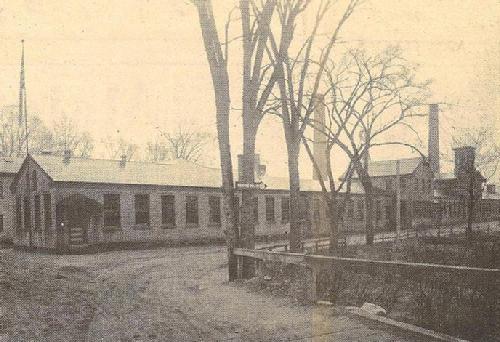
According to an account in The
Hamden Chronicle, the building had been erected in 1835 by James Ives as
the Mt. Carmel Brass Works. Later, it
was occupied by W. Woodruff and Sons, which manufactured various hardware items
during the early half of the 20th Century.
At the time of
the fire, the principal occupant of the building was the George W. Fleming Co.,
manufacturers of cutlery (see related story at the bottom of this page).
However, the
manufacturing end of the business had moved to Wallingford only a few months
earlier. By the time of the fire, the
Fleming Co. portion of the building was being used only as a warehouse for
their products. The Ives Street end of the building complex
previously housed the Sterling Beverage Co.
By January 1968, Sterling Beverage had rented their part of the building
to the Cott Beverage Co. of New Haven for storage.
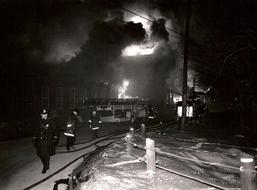
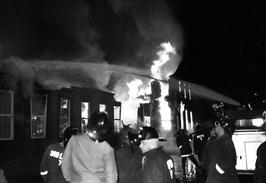
With the building well involved
when the first apparatus arrived, the main objective was saving the undamaged
portions of the structure, as well as protecting the adjacent exposures on
Broadway. The home of the Rexford Barnes
family, right next door at 40 Broadway, was only about twenty feet from the
southern end of the building.
It was a bitter cold night, with
temperatures hovering around zero.
Parallel 2½” water supply lines were pumped from a 3-way hydrant on Ives
Street near New Rd. Two ancient 2-way
hydrants were located further down Broadway at #58 and #100, and at least one
of them was frozen. The Register
reported, “Hose lines were stretched to nearby Mill River in order to pump
water, but Chief [V. Paul] Leddy noted that firemen had some difficulty with
pumps freezing intermittently.”
Retired Battalion Chief Thomas
Doherty, a seven-year veteran at the time, recalls having been recently
transferred from Headquarters (now Station 4) to Station 2, where he was assigned
to drive Ladder 1, a 1958 Maxim 75-foot aerial ladder truck. When the alarm sounded, Firefighters Doherty
and Bill Mulcahy responded from Station 2 in the open-cab truck in sub-zero
temperatures. Today, Chief Doherty
recalls that by the time they got to the fire they were both frozen stiff. They were ordered to set up the aerial
ladder pipe to protect the Ives Street end of the building, which was saved and
remains standing to this day. Despite
the intense radiant heat and flying brands, efforts to protect the Barnes’ home
and the other homes immediately south of the building were successful, as well.
Firefighters Ed Doiron and Mickey Cantarella were on
Engine 6 at 21 Merritt Street. The only
paid company left in service, they relocated to Station 3 on Putnam Avenue to
cover the town with Volunteer Co. 8.
[NOTE: No career firefighters
were assigned to Co. 9 until the “new” Station 9 was opened in December 1968.]
|
 |
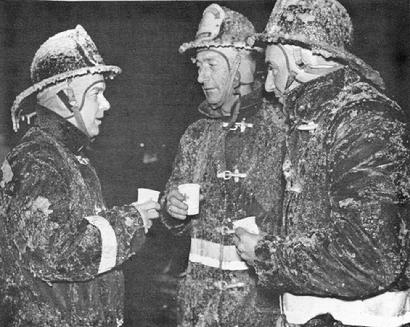
| Ff. Charlie Carlson, Lt. Ken Harrington and Ff. Joe Shields take a break after the fire was under control. |
|
The shift commander was Deputy
Chief Joseph Hromadka (above in white helmet), who told the Register that
the blaze was “one of the largest that he could remember” in his 32 years on
the Department. Chief Hromadka was one
of the original two shift commanders to be appointed from among the ranks of
the career firefighters when the Department was reorganized with paid officers
in 1942.
Having joined Volunteer Co. 5 in
October 1966, I did not yet have a “Plectron” radio, the dinosaur plug-in
ancestor of today’s pagers. So, after
two morning classes at SCSC, I finally got to the scene well after the fire had
been knocked down, but just in time to help roll up the hundreds of feet of 2½
that had spaghettied all over Broadway.
As I recall, the firefighters on Engine 5 that day
shift were Robert “Ace” Callahan and Ray Carofano. Once the hose was rolled up, a fellow Co. 5 volunteer, Bill
Kelly, and I rode Engine 5 to Station 2 to help change hose. This was my first ride on a tailboard.
When we arrived at 2’s, the “paid guys” were
only too happy to let us assist in repacking Engine 5 with 1,000 feet of fresh
2½. We were eager to pitch in and
learn how to keep the end folds even with something called a "Flying Dutchman."
This was still a couple of years before all hose beds were split into
separate bays of 2½” and 3” hose for parallel lays, and seventeen years before
the introduction of large diameter hose.
|
Some modern historians say that
1968 was a transitional year for America.
On a somewhat smaller scale, 1968 was also a transitional year for the
Hamden Fire Department.
At the time of
the Fleming Company fire in January, Engine 1 was a 1938 Seagrave 600 g.p.m.
pumper at Station 2 – the Department’s spare.
Engine 2 was a 1959 Maxim “cab-forward” 750 g.p.m. pumper.
Engine 3 was a 1954 Maxim 750 g.p.m. pumper.
Engine 4 was a 1965 Mack 750 g.p.m. pumper,
the Department’s first commercial-chassis apparatus since the Diamond-T engines
of the early 1940s.
And Engines 5 &
6 were identical 1951 and 1952 Maxim 750 g.p.m. pumpers.
In 1968, Hamden’s first paid Fire
Marshal, Al Purce, and the first Superintendent of Alarms & Apparatus, Clem
Wetmore, were both nearing retirement but were still on the job.
The Department’s only ladder truck was the
aforementioned 1958 75-foot Maxim “Junior” Aerial at Station 2. The rescue units – this was three years
before Hamden’s first group of EMTs – were 1958 and 1960 International
Travelalls, similar to today’s Chevy Suburbans.
By the end of 1968, the Town had purchased two new identical Maxim S-model 1000 GPM pumpers that were placed in service at Stations 3 and 4. The 1965 Mack became Engine 2. The 1959
Maxim cab-forward became Engine 1, and the 1938 Seagrave "canopy-cab" was sold, regrettably, to a party who scrapped it for the value of its brass pump.
Hamden's first new fire station since the Hamden Fire Department was created under the Connecticut General Statutes in 1925 was dedicated on December 8, 1968. Station 9 opened with one paid man on each of the
three platoons. "Paid" Engine 9 was the 1951 Maxim pumper.
By the end of 1968, Marshal Purce and Supt. Wetmore had
retired. Their vacancies were filled by Captain
Bob “Bubby” O’Donnell and Asst. Supt. Richard Lostritto, respectively.
Also in 1968, the Town and the
Hamden Paid Firemen’s Sick Benefit Association, which had become the bargaining
unit for non-management fire personnel, agreed on the implementation of a
42-hour workweek to commence on October 5, 1970. Since 1951, line personnel had worked an average of 56 hours a
week (four days on, two days off, etc.).
Two years later, old Station 3 on Putnam Avenue and Station 6 on Merritt Street were
both closed when “new” Station 3 opened at Hartford Turnpike and Ridge Road in September of
1970. The new station housed Engine 3,
Engine 6, Rescue 1, the Deputy Chief (shift commander), and a second truck
company, Ladder 2, a new 1970 Maxim 100-foot aerial truck.
When they were delivered in the late 1950s, the 1958 Maxim aerial ladder
truck and the 1959 Maxim “cab-forward” pumper were both painted white, the Hamden Board of Fire Commissioners being somewhat enamored of the New Haven "look." But in 1971, five years after a charter revision put the fire chief squarely in charge of the Department, the 1958 Maxim ladder and the 1959 Maxim pumper were repainted red. The truck also received a new convertible-type soft top that kept the rain off
your head, but did little to abate the frigid winter temperatures.
The '58 Maxim aerial ladder truck remained at Station 2 until April 9, 1976, when
it was transferred to Station 5’s new annex built the previous
year. In November of 1984 the truck was transferred once again, this time to to Station 9. The following year, it was removed from service and redesignated "Truck 2." The 1970 100-foot
aerial ladder truck, now designated “Truck 1,” became the Department’s only
truck company. Both trucks were
retired in early 1990.
The two white International rescue
trucks were removed from service in 1971 when the
Department’s first “modular” unit, Rescue 1, was assigned to Station 4. The ornate gold leafing that decorated the
new bright red 1971 Ford cab and box resulted in the somewhat whimsical, if not
affectionate nickname, “the Circus Wagon.”
For the next several years, Engine 2 handled all rescue calls in the
south end of Hamden. With the
introduction of paramedic service, Rescue 2, on a 1975 Ford chassis, went in
service at Station 2 on April 9, 1976.
Engine Co. 6 at new Station 3 was deactivated in 1974. The 1959 Maxim
“cab-forward,” which had been Engine 1 from 1968 to 1974, was moved to Station 3 and became Engine 6, the Department’s
permanent spare pumper. In 1981, it was
repowered with a new diesel engine and remained in reserve until the
early 1990s.
Dave Johnson
Captain
Hamden Fire Department (Ret.)
January 8, 2008
Originally posted on the Local 2687 website - 1/12/08
|

CLICK on any of the three photos below to enlarge them.
|
CLICK on any of the three photos below to enlarge them.
|
CLICK on any of the three photos below to enlarge them.
|
 |
| © 1968 - The New Haven Register |
|
|
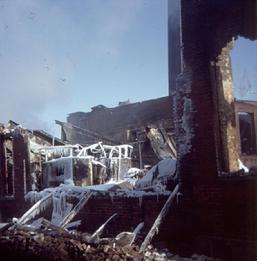
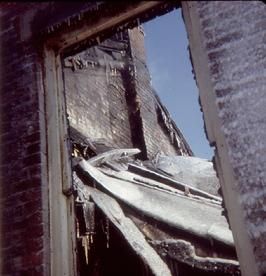
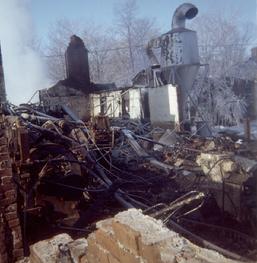
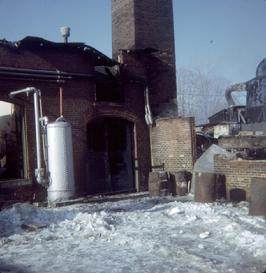
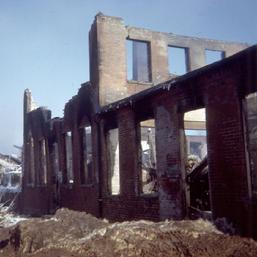
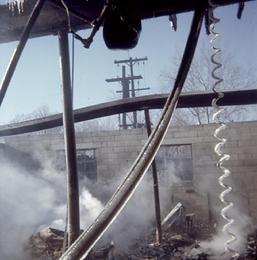
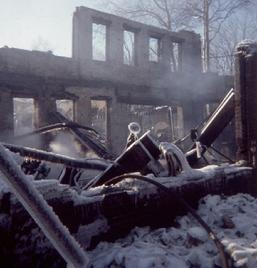
Tom Doherty was on Ladder One on the night of the Fleming Co. fire. After being relieved by the day shift, Tom took a dozen color slides of the aftermath of the fire - shown below.
Each of these photos may be enlarged by clicking on them.
|
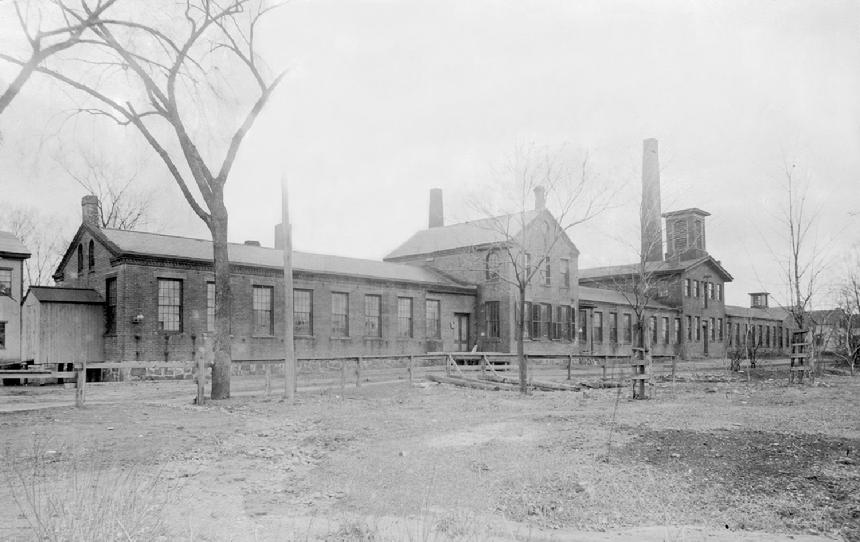
At the turn of the 20th Century
|
 |
| Photo courtesy of the Hamden Historical Society |
|
|
|
According to an account in The Hamden Chronicle, the building had been erected in 1835 by James Ives as the Mt. Carmel Brass Works. Later, it was occupied by W. Woodruff and Sons, which manufactured various hardware items during the early half of the 20th Century.
|
 |
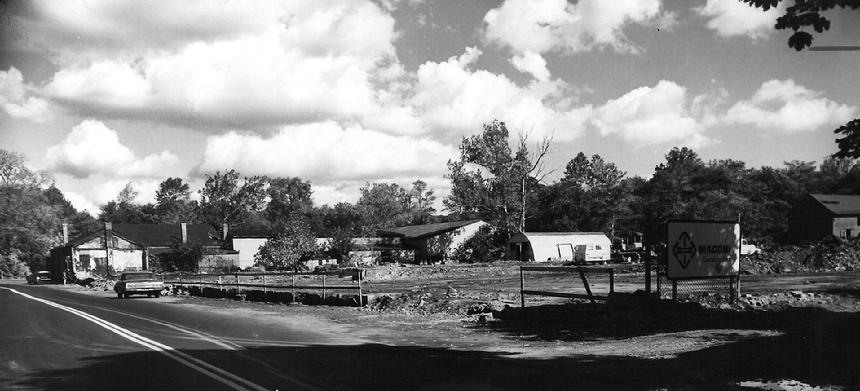
| Aftermath - A few months later (Photo by I.A. Sneiderman) |
|
|
 |
| January 12, 2008 - Forty Years Later |
|
|
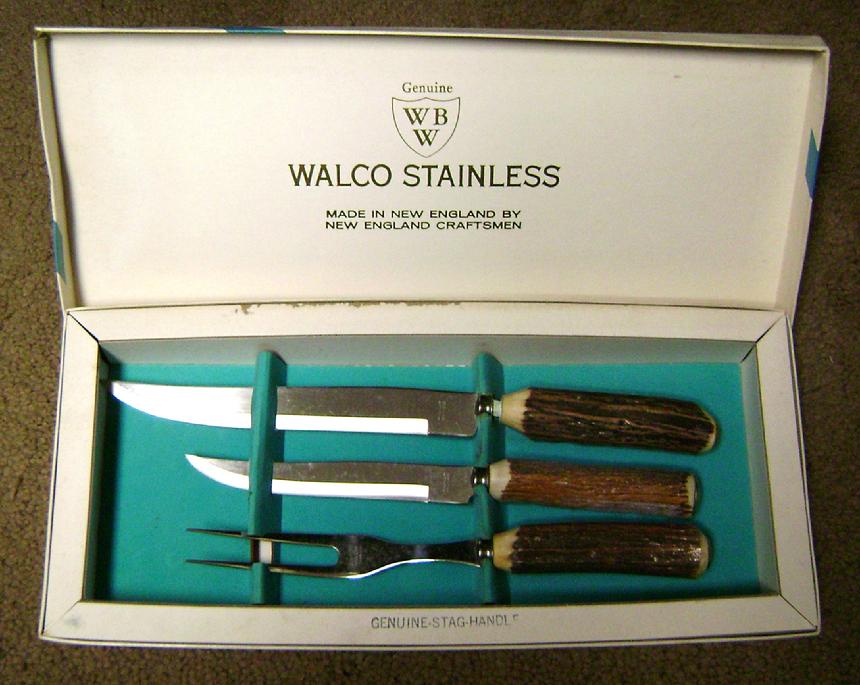
And now for the rest of the story . . .
|
Hundreds of these cutlery sets were being warehoused at the Fleming Co. the night of the fire. After all the hose was taken up, some of these souvenirs found their way out of the rubble and back at the fire stations. This resulted in a sternly worded admonition from Chief Leddy that all cutlery liberated from the Fleming Co. shall be returned to the watch desk at Headquarters - "no questions asked." This particular set, in pristine condition, was donated by an unnamed 1968 "paid guy," who apparently never read the memo.
Posted 1/20/12
|
|